
Why Breakpoint Detection Matters?
When a cable’s internal medium is damaged, the fault is hidden beneath the insulation and cannot be seen visually. Maintenance teams often troubleshoot in sections, measuring voltage or continuity at multiple points to narrow down the fault location. Accurate detection minimizes unnecessary cable replacement and ensures system reliability.
Proven Methods to Detect Cable Breakpoints
-
Multimeter Detection Method Connect one end of the cable to a live wire, leave the other end unconnected, and use a multimeter to track voltage along the cable. Sudden drops in voltage indicate the breakpoint location. This method works well for shorter cables.
-
Inductive Pen Detection An induction test pen can detect voltage and continuity. By moving the pen along the cable, technicians can locate the breakpoint within a margin of 10cm. This method is effective for short to medium cable lengths.
-
Audio Detector Audio detectors send single or complex frequency signals through the cable to identify continuity faults. This non-invasive method avoids peeling insulation and quickly pinpoints breakpoints.
-
Cable Fault Tester Cable fault testers are comprehensive tools capable of detecting high-resistance faults, grounding issues, short circuits, and disconnections. Equipped with acoustic measuring pointers, they provide precise fault locations for power and communication cables.
-
Broken Line Detection Method By connecting a multimeter across a cable and bending sections, technicians can identify intermittent faults. This technique is suitable for short cables with frequent bending points.
-
Acupuncture Test (Not Recommended) Steel needles are inserted into the cable to measure continuity, but this damages insulation and is risky in high-humidity environments.
-
Pulling Wire Detection (Not Recommended) This method involves physically pulling the cable to locate faults near the ends. It is rarely used due to the risk of further insulation damage.
How Wrindu Cable Fault Test Systems Help?
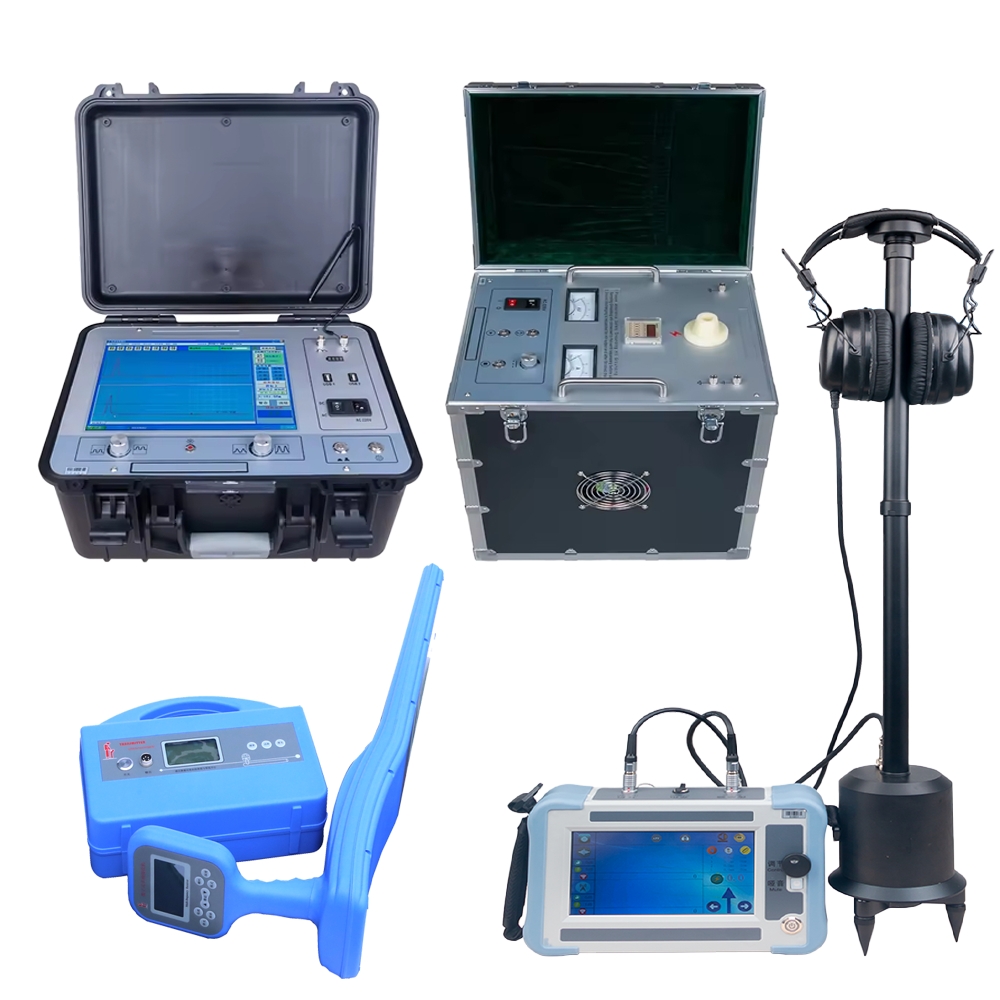
Wrindu’s RDCD-Ⅱ Cable Fault Test Systems provide a comprehensive solution for detecting and locating cable faults efficiently and accurately. Designed with years of innovation and modern power electronics technology, these systems help engineers, maintenance teams, and utilities quickly identify issues in high-frequency coaxial cables, telephone lines, street lighting cables, and buried power lines up to 35kV.
Accurate Fault Location: The system combines advanced instruments such as the RDCD-II/502 Cable Fault Pre-Locator and RDCD-II/503D Cable Fault Locator. Using low-voltage pulse, high-voltage flashover, and acoustic-magnetic synchronization technology, Wrindu systems pinpoint fault points with high precision, often within 0.1 meters. This eliminates guesswork and reduces downtime.
Comprehensive Testing Capabilities: Wrindu systems detect a wide range of cable faults, including low-resistance, short circuits, open circuits, broken lines, high-resistance leakage, and flashover faults. The RDCD-II/535T High-Voltage Signal Generator delivers stable, controlled pulses, while the RDCD-II/507 Pipeline Detector maps underground cable routes and measures depth, ensuring safe and reliable fault tracing.
User-Friendly and Field-Ready: With industrial touch-screen interfaces, automatic waveform recording, and portable lithium-ion power supplies, Wrindu systems are designed for ease of use in the field. Engineers can store, compare, and analyze waveforms on-site, improving test efficiency and accuracy.
Efficiency and Reliability: By integrating modern signal processing, noise reduction, and route auxiliary testing, Wrindu systems reduce false readings and environmental interference. Maintenance teams can locate faults faster, plan repairs more efficiently, and minimize operational disruption.
Why Choose Wrindu?
Wrindu Cable Fault Test Systems combine high precision, comprehensive fault detection, and portability, providing engineers and decision-makers with a reliable solution for managing power and communication networks.
For more information, visit official website: www.wrindu.com / www.hvtesters.com
For more technical blogs, visit official website: blog.wrindu.com
Media Contact
Company Name: Rui Du Mechanical and Electrical (Shanghai) Co., Ltd.
Contact Person: Wrindu
Email:Send Email
Phone: 13661908522
Address:No.500 Jianyun Road, Pudong New Area
City: Shanghai
Country: China
Website: https://www.wrindu.com/

