
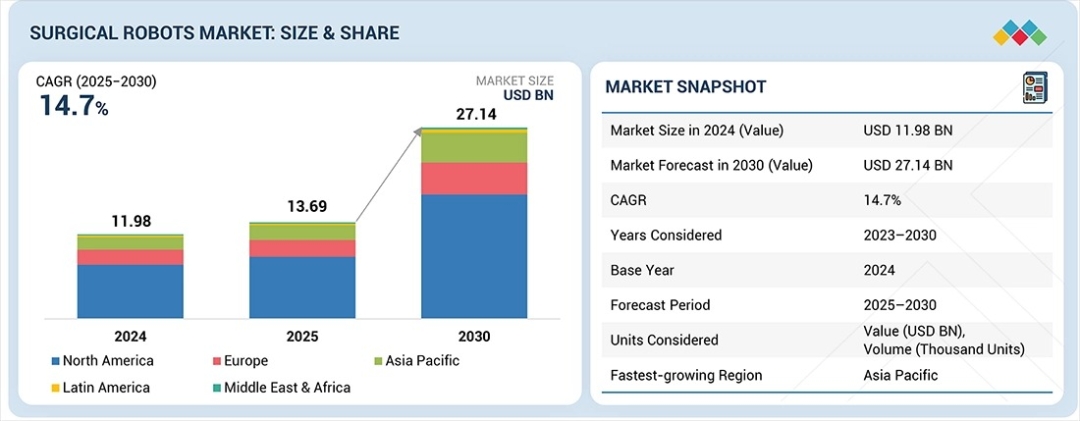
The global Surgical Robots Market is experiencing unprecedented expansion, valued at $13.69 billion in 2025 and projected to reach $27.14 billion by 2030, representing a robust compound annual growth rate (CAGR) of 14.7%. This accelerating trajectory reflects a fundamental shift in how healthcare systems worldwide are approaching surgical care, driven by converging clinical, economic, and technological imperatives that are reshaping the competitive landscape across hospitals, surgical centers, and medical device manufacturers.
Download PDF Brochure: https://www.marketsandmarkets.com/pdfdownloadNew.asp?id=256618532
What is Driving This Transformation?
The market's extraordinary growth is fueled by healthcare systems' rapidly escalating demand for minimally invasive surgical techniques that deliver measurable clinical and economic advantages. Robot-assisted surgery has emerged as the gold standard for precision-critical procedures, offering surgeons enhanced dexterity, tremor filtration, and superior high-definition 3D visualization—capabilities that substantially exceed traditional laparoscopic methods. These technological advantages translate directly into tangible patient benefits: reduced postoperative pain, shorter hospital stays, faster recovery timelines, and dramatically lower complication rates.
The aging global population and rising prevalence of chronic diseases—including cancer, cardiovascular disorders, and complex orthopedic conditions—are creating unprecedented demand for high-precision surgical interventions. Simultaneously, rapid technological innovation, particularly the integration of artificial intelligence, machine learning, and real-time imaging systems, is expanding the clinical efficacy and applicability of robotic platforms across specialties including orthopedics, neurosurgery, bariatric surgery, and cardiothoracic procedures.
Why Are Healthcare Leaders Prioritizing Robotic Adoption Now?
For C-suite healthcare executives, the strategic imperative is clear: robot-assisted surgery simultaneously enhances clinical outcomes, improves operational efficiency, and strengthens competitive market positioning. Healthcare providers leveraging robotic platforms report superior procedural consistency, fewer complications, reduced length of stay, and enhanced patient satisfaction—all critical metrics driving value-based reimbursement and competitive differentiation. Growing hospital investments in robotic infrastructure, expanded surgeon training and proctoring programs, and improving reimbursement frameworks are collectively removing historical barriers to adoption.
Patient demand is equally significant. Rising awareness of minimally invasive options is shifting market preferences toward safer procedures with accelerated recovery trajectories, compelling healthcare systems to modernize their surgical capabilities to remain competitive.
Market Composition: Where the Value Resides
The instruments and accessories segment commands the market's largest share, driven by the recurring nature of robotic consumables. Staplers, energy devices, trocars, end-effectors, and single-use instruments require regular replacement after a fixed number of procedures, creating continuous revenue streams that directly correlate with surgical volumes. This structural characteristic ensures sustained market momentum as hospitals expand robotic program utilization.
General surgery dominates by application, accounting for the highest procedural volume across hernia repair, cholecystectomy, bariatric surgery, and colorectal interventions—all procedures ideally suited for robotic precision and dexterity. Hospitals and clinics remain the primary adopters, possessing the advanced infrastructure, trained surgical teams, and financial capacity to maximize return on investment through high-volume utilization.
What Barriers Remain?
Despite exceptional growth prospects, substantial adoption challenges persist. The capital intensity of robotic systems—encompassing complex hardware, advanced sensors, imaging modules, sophisticated software ecosystems, and continuous maintenance—demands significant long-term investment commitments. Operating room redesign, infrastructure adaptation, and extensive staff training requirements create logistical and financial hurdles, particularly for resource-constrained healthcare facilities with lower procedure volumes or limited technical capacity.
Surgical error management and safety protocols remain critical focal points for regulators and clinical teams. While robotic systems enhance precision, system malfunctions, software anomalies, and inadequate operator training can introduce operational risks. These concerns necessitate rigorous validation, performance monitoring, and continuous professional development programs to sustain clinical trust and regulatory confidence.
Request Sample Pages: https://www.marketsandmarkets.com/requestsampleNew.asp?id=256618532
Where Is Growth Accelerating Most Rapidly?
Asia Pacific is emerging as the fastest-growing regional market, driven by healthcare modernization initiatives, substantial public and private sector investments, and rising patient demand for advanced surgical capabilities. China, Japan, South Korea, India, and Australia are aggressively expanding robotic surgery programs through government funding and targeted infrastructure investments. The region's large population base, escalating chronic disease burden, expanding surgeon training ecosystems, and growing medical tourism are converging to create exceptional demand. As local manufacturers introduce cost-effective platforms, accessibility is broadening significantly, reinforcing Asia Pacific's leadership trajectory.
Market Leadership and Competitive Dynamics
The surgical robotics ecosystem encompasses leading innovators including Intuitive Surgical, Stryker, Medtronic, Smith+Nephew, and Zimmer Biomet, alongside emerging competitors such as CMR Surgical and Globus Medical. These organizations are continuously advancing robotic platform capabilities, developing specialty instruments for specific surgical domains, and expanding training and support infrastructure to accelerate market penetration.
How Is the Market Evolving Beyond Traditional Hospital Settings?
A significant emerging opportunity lies in ambulatory surgical centers (ASCs). As robotic platforms become increasingly compact, modular, and operationally efficient, ASCs are emerging as attractive deployment venues for minimally invasive procedures across orthopedics, urology, gynecology, and general surgery. This shift toward outpatient robotic procedures, supported by advances in anesthesia protocols and postoperative care pathways, is democratizing access to advanced surgical capabilities while creating new revenue channels for manufacturers and expanding market penetration significantly.
Related Reports:
Minimally Invasive Surgical Instruments Market
Media Contact
Company Name: MarketsandMarkets™ Research Private Ltd.
Contact Person: Mr. Rohan Salgarkar
Email:Send Email
Phone: 18886006441
Address:1615 South Congress Ave. Suite 103, Delray Beach, FL 33445
City: Florida
State: Florida
Country: United States
Website: https://www.marketsandmarkets.com/Market-Reports/surgical-robots-market-256618532.html

