

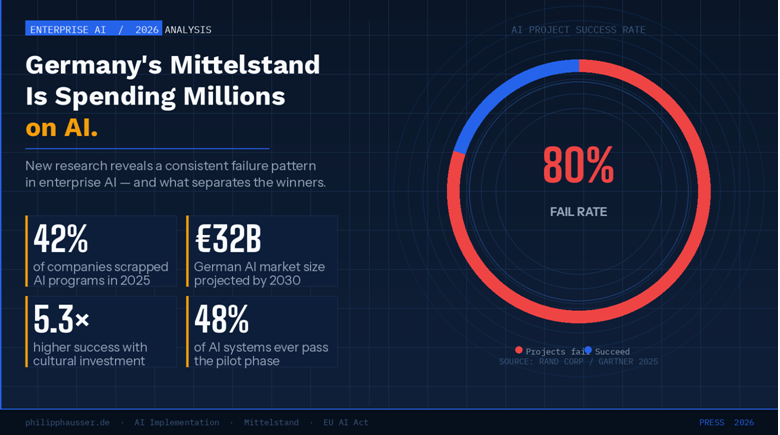
Global enterprise AI investment crossed $252 billion in 2024. Most of it is not working.
Research from RAND and Gartner puts the AI project failure rate at 80 to 85 percent. That is roughly twice the failure rate of conventional technology projects. A 2025 S&P Global survey found that 42 percent of companies scrapped most of their AI programs that year, up sharply from 17 percent in 2024. Only 48 percent of AI systems ever make it past the pilot phase.
For Germany's Mittelstand, the stakes are particularly high. A January 2026 study by management consultancy Horvath found that mid-sized German companies invested just 0.35 percent of revenue in AI last year. The broader market average was 0.5 percent. The German AI market is projected to grow from 10 billion euros today to more than 32 billion euros by 2030. The investment gap is widening at exactly the wrong moment.
“The model rarely breaks. What buckles is everything around it — the data, the processes, and the people.”
WHY PROJECTS FAIL?
The research points to the same causes, repeatedly. According to Informatica's 2025 CDO Insights report, the top barriers to AI success are poor data quality (43 percent), lack of technical maturity (43 percent), and insufficient staff skills and data literacy (35 percent).
McKinsey found that culture, not technology, is the single biggest obstacle to digital transformation. Organizations that invest seriously in cultural change achieve 5.3 times higher success rates than those focused on technology alone. Fewer than 30 percent of companies report their CEO actively sponsors the AI agenda. That gap reliably predicts failure.
BCG's findings are equally direct. 74 percent of companies have yet to generate tangible value from AI. 60 percent are seeing little material return. Companies running isolated AI experiments capture 5 percent or less of potential cost savings, compared to 25 percent for organizations that redesign their workflows before selecting any technology.
The failure pattern is not random. It is consistent, well-documented, and largely preventable.
A NEW MODEL IS EMERGING
The implementation model that produces results starts differently. It begins with a specific business problem, not a technology wish list. It treats data readiness as the primary investment before a single model is selected. It deploys AI as a live operational product with defined outcomes, not a project with a handoff date. And it brings the workforce in from day one, because that is where most programs succeed or collapse.
Philipp Hausser has spent eight years applying exactly this model inside a company that operated for 55 years as a fully analog business. He has overseen AI projects in the million-euro range, deployed production chatbot systems using RAG architecture, built learning analytics platforms, and guided an organization through EU AI Act compliance. The work was done from the inside, not from a presentation deck: responsible for the contracts, the system architecture, and the people who had to use it.
As an AI Keynote Speaker Germany, author, and podcast contributor, Hausser brings that operational experience to conferences and executive teams across the German-speaking world. As a Digital Transformation Speaker, his focus covers AI implementation in the Mittelstand, organizational change management, and EU AI Act readiness. The central message is straightforward: less hype, more working system.
ABOUT PHILIPP HAUSSER
Philipp Hausser is a German AI implementation specialist, keynote speaker, author, and podcast guest. He specializes in AI strategy and governance, production AI systems including RAG-based chatbots and workflow automation, and change management for AI adoption in the Mittelstand. He is available for speaking engagements, media interviews, podcast appearances, and editorial contributions on AI strategy and EU AI Act compliance.
Media Contact
Company Name: Philipphausser
Contact Person: Philipp Hausser
Email:Send Email
Address:Elsenheimerstraße
City: Munich
State: Bavaria
Country: Germany
Website: https://www.philipphausser.de/

