
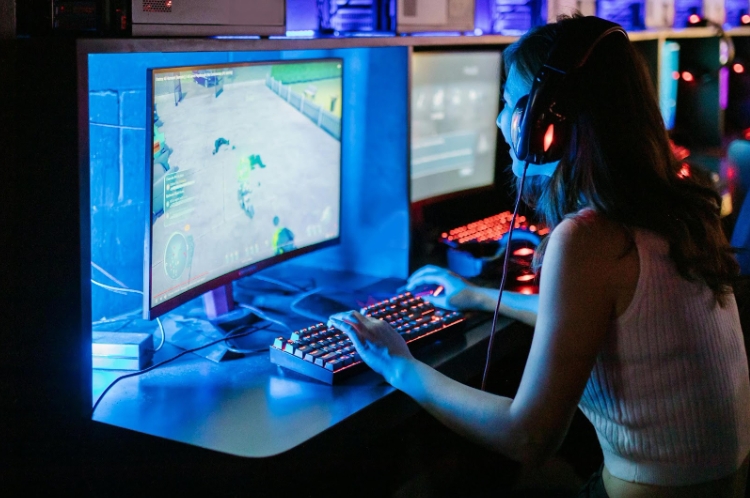
Digital items used to sit quietly in the background of games. A skin looked nice. A cosmetic badge marked a season. A rare drop was a small moment of luck and then the match moved on.
That’s not how players talk about inventories now. In long-running online titles, collections build over years, not weeks. Items arrive through seasonal updates, competitive play, timed events and the kind of slow accumulation that only happens when a game becomes part of someone’s routine.
In that world, trust infrastructure matters. Gaming marketplaces that prioritize secure infrastructure are becoming central to digital item trading and platforms such as GG Chest provide monitored exchanges and verification procedures designed to protect both buyers and sellers.
The Scale Behind Digital Items
It helps to start with the size of the gaming economy itself, because secondary markets do not grow in a vacuum. The bigger the ecosystem, the more “stuff” exists inside it and the longer those ecosystems last, the more that stuff starts to matter.
Newzoo estimates the global games market generated $187.7 billion in 2024. That figure is not about one platform or one title. It’s the combined weight of mobile, console and PC. It also hints at why in-game items have become so culturally visible. When millions of people share the same digital spaces every day, certain cosmetics become familiar in the way sports jerseys do. You recognize them. You remember when they appeared. You associate them with a player, a team, or a season.
That’s the subtle shift. Items are no longer only decoration. In some communities they become identifiers.
And once items become identifiers, the desire to obtain specific ones becomes less random. It turns into preference. Collection. Curation.
How Player Demand Turned Cosmetics Into Markets
Counter-Strike is one of the clearest examples because its skin culture has been around long enough to show the full arc: cosmetic novelty, community recognition, then an economy built on exchange.
What’s striking is not that skins have value. It’s how durable demand can be when a cosmetic becomes part of a game’s shared memory. Some designs become staples. Others feel tied to a particular period of play. Certain items are simply hard to replicate socially, even if they are easy to describe.
At the top end, the Counter-Strike skin economy has been estimated to reach a market cap of about $6.08 billion at its peak. The number is often cited to illustrate scale, but it also points to something more practical: once an ecosystem reaches that size, trading is no longer just “players swapping items.” It becomes a set of recurring transactions that need consistent rules, consistent processes and consistent trust signals.
That is why marketplaces in this space increasingly resemble mainstream digital commerce. Not in tone. In plumbing.
Security Systems That Make Secondary Markets Work
In secondary item markets, the question is rarely “is there demand?” The question is whether participants can rely on the transaction process itself.
Platforms that take security seriously tend to converge on a few building blocks:
-
Identity and account verification so participants are not operating behind endlessly recyclable identities.
-
Monitored exchange steps so the platform can track a transaction from initiation to completion.
-
Controlled delivery flows that reduce confusion about when an item moved and under what conditions.
You can think of it as the difference between a handshake deal and a checkout system. Both can work. But only one scales cleanly.
This is also where the tone of the market changes. Secure systems don’t just prevent problems; they change behavior. When sellers know the process is monitored and buyers know there is a structured flow, participation looks less like a forum swap and more like standard online commerce.
As these marketplaces grow, the importance of reliable transaction systems continues to increase. Players want clarity about how items move between accounts and confidence that exchanges follow a clear process from start to finish.
In other digital marketplaces, escrow-style approaches are a common way to protect both sides by holding value until terms are met. In gaming item markets, the specifics differ, but the idea is similar: reduce uncertainty inside the transaction itself.
Why These Economies Keep Expanding
This isn’t about one title. It’s about the shape of modern games.
Live-service design keeps producing new items. Competitive scenes keep making certain cosmetics visible. Streaming keeps turning visual identity into part of the entertainment. Long-running games keep creating “older” items that feel different simply because they belong to an earlier era.
Meanwhile, marketplaces keep improving the mechanics of trust: verification, monitoring, controlled transfers and clearer transaction records. When those systems are in place, item exchange becomes less of a side activity and more of a stable layer around the game.
As gaming communities continue to grow, the role of digital inventories is likely to expand as well. Players increasingly see certain items not just as cosmetics but as recognizable parts of a game’s culture and history.
Digital items started as decoration. In many communities they now function as recognizable, collectible assets that circulate through increasingly structured secondary markets, supported by security systems built to protect both sides of the exchange.
Media Contact
Company Name: GG Chest
Email:Send Email
Country: Lithuania
Website: https://ggchest.com/

