
Growing Demand for Data-Based Visual Products
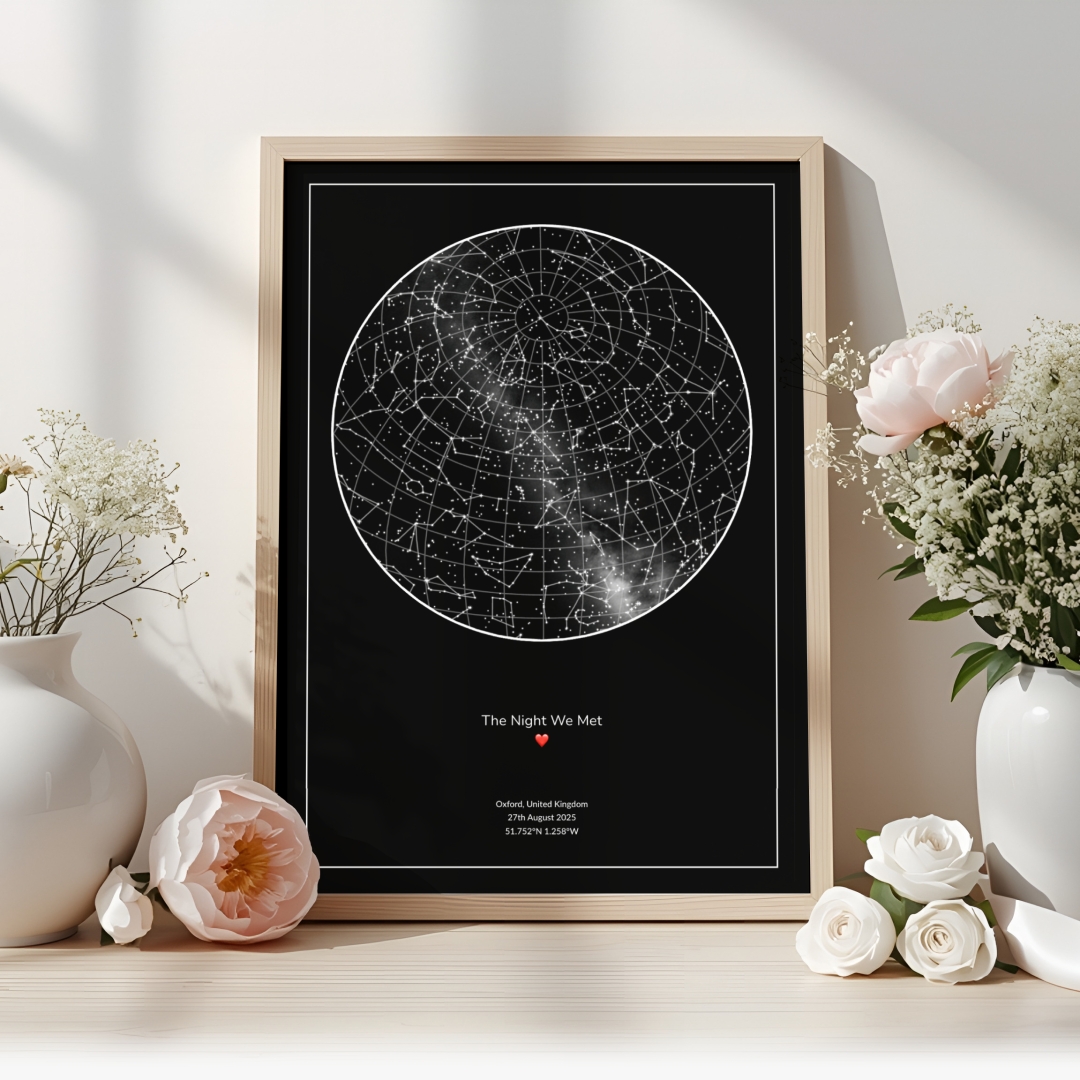
Across multiple industries, from geospatial analytics to personalised media, consumers increasingly expect products to be grounded in real-world data rather than symbolic representations. In the astronomy visualisation segment, this means star and moon maps generated from historical coordinate datasets instead of stock imagery.
This demand aligns with a wider shift toward traceable data outputs, where customers value the ability to understand how a product is created and what information it is based on.
How Data-Driven Star Maps Are Generated
Pictue the stars data-driven star maps are created by combining time-stamped astronomical coordinate datasets with geographic modelling. To reproduce the night sky as it physically appeared at a specific moment, platforms must calculate:
-
The exact date and time (with time-zone alignment)
-
Latitude and longitude of the observation point
-
The Earth’s rotation and axial tilt
-
Long-term star position shifts (precession)
-
Orientation, field of view, and sky projection
These variables allow the system to determine the position of each visible star relative to the observer at that precise time.
Lunar maps apply similar orbital mechanics to calculate the Moon’s phase, illumination, and position in the sky for the selected date and location.
Platform Optimisation and Infrastructure
Picture The Stars has continued to optimise its data processing and rendering systems to support higher volumes of personalised visual outputs.
The platform integrates astronomical coordinate data with geographic and time-based calculations to generate sky simulations at scale. Recent optimisation efforts have focused on improving rendering performance, expanding data-handling capacity, and refining projection models to preserve spatial accuracy.
Transparency and Data Methodology
As data-driven products become more common, transparency around methodology has become an important differentiator. Consumers increasingly want to understand:
-
What data sources are used
-
How calculations are performed
-
Whether outputs are reproducible
-
How accuracy is maintained across different locations and dates
Picture The Stars provides an overview of its data sourcing and computational process on its astronomical data methodology
Looking Ahead
The growth of the personalised astronomy segment reflects a broader trend toward technically accurate, data-backed visualisation. As demand continues to rise, platforms that combine scientific credibility with scalable infrastructure are expected to play an increasingly important role.
Picture The Stars continues to invest in platform optimisation and fulfilment to support this shift.
Media Contact
Company Name: Picture Made Prints Ltd
Contact Person: Ricky Bendall
Email:Send Email
Phone: 07507782580
Address:L2.5 Ivy Buisness Centre Crown street
City: Fasilsworth
State: Manchester
Country: United Kingdom
Website: https://picturethestars.co.uk/

