

As makers, designers, and hobbyists push toward increasingly intricate projects, the limitations of traditional power tools have become more apparent. While electric rotary tools have long dominated workshops, their design priorities have historically favored power and speed over finesse. In response, a quieter but important shift has been taking place in the world of precision finishing: the rise of reciprocating sanding.
At the center of this evolution is a growing understanding that detail work demands a fundamentally different motion, one that emphasizes control, stability, and precision rather than brute force. NeoSander represents a recent example of how reciprocating sanding technology is being reimagined for modern creators.
Why Traditional Electric Rotary Tools Fall Short in Detail Applications

Rotary tools remain a cornerstone of many toolkits, particularly for tasks that involve rapid material removal. Their strengths are well established. High rotational speeds allow them to reshape surfaces quickly, and their power output makes them effective for heavy-duty applications.
However, these same characteristics become liabilities when working on fine details. Excessive torque can overwhelm small or delicate parts, increasing the risk of over-sanding or structural damage. Beginners often struggle with controllability, while experienced users must compensate constantly to prevent slipping, gouging, or uneven finishes. Rotary tools are inherently optimized for bulk material removal, not for precision sanding in tight corners, thin walls, or intricate geometries.
As projects in areas such as model making, jewelry design, and 3D printing become more complex, the need for a different approach has become increasingly clear.
Reciprocating Sanding: A Promising but Historically Limited Direction
Reciprocating sanding offers a fundamentally different motion: a controlled back-and-forth stroke rather than continuous circular rotation. In theory, this motion allows for cleaner contact with surfaces, improved edge control, and better access to narrow spaces.
In practice, however, most existing reciprocating sanding tools have struggled to realize this potential. The majority operate at relatively low frequencies, typically between 3,600 and 6,000 strokes per minute. To compensate, manufacturers have relied on large stroke amplitudes. While this increases coverage, it also introduces new problems, including limited efficiency, reduced precision, and noticeable hand vibration.
As a result, reciprocating sanding has remained underdeveloped, not because the concept is flawed, but because motor performance and mechanical design have lagged behind the needs of precision users.
The Role of High-Speed Linear Reciprocating Motors
Linear reciprocating motors are not a new invention. They have been used for decades in industrial automation and high-precision systems where accuracy and repeatability are essential. Historically, their adoption in handheld tools has been constrained by complex electronic control requirements, high stability demands, and the difficulty of miniaturization.
Recent advances in motor control, miniaturization, and balance mechanisms have begun to make high-frequency reciprocating motion more viable in handheld tools.
What High-Speed Linear Reciprocating Systems Make Possible
One recent example is a compact handheld tool developed by HOZO, which applies these principles in a palm-sized form factor. NeoSander is built around three central engineering advances that collectively redefine what reciprocating sanding can achieve.
High Frequency Without Brute Force
At the heart of NeoSander is a high-speed linear reciprocating motor capable of reaching up to 13,000 strokes per minute. This frequency is more than three times faster than typical reciprocating sanding pens. Instead of increasing force or stroke length, higher frequency creates more contact cycles per second, improving sanding efficiency while maintaining a gentle, controlled touch.
Precision Through Low Stroke Amplitude
Where traditional designs increase stroke amplitude to improve speed, NeoSander takes the opposite approach. By increasing frequency and reducing stroke amplitude to a range of 0.6 to 1.8 millimeters, the tool achieves over a 50 percent improvement in precision compared to standard reciprocating designs. This enables greater control in corners, edges, and thin-walled parts, with good concentricity below 0.05 millimeters, achieving concentricity levels typically associated with industrial-grade systems.
Stability Through Counter-Balanced Design
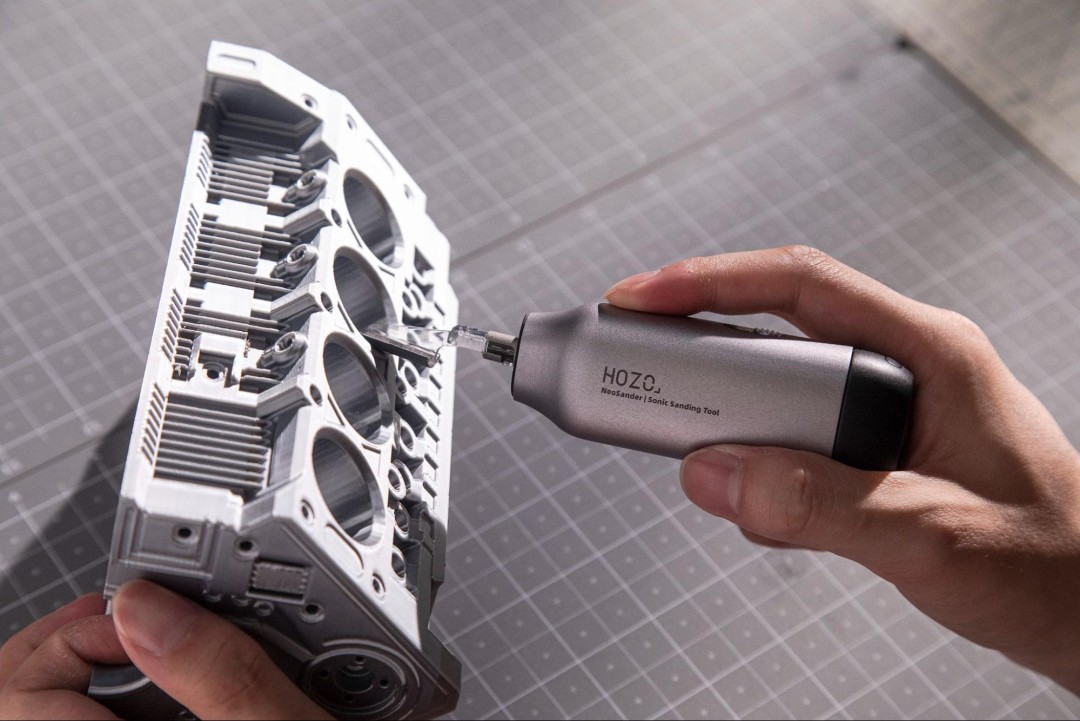
Vibration has long been a challenge for reciprocating tools. NeoSander addresses this through a counter-balanced reciprocating system, where each forward motion is offset by a reverse-moving counterweight. This mechanical solution reduces perceived hand vibration by approximately 85 percent, allowing stability to be built into the tool itself rather than relying on user compensation.
Reciprocating vs. Rotary: Complementary, Not Competitive
Rather than replacing rotary tools, reciprocating sanders occupy a complementary role. Rotary tools remain ideal for large surfaces, rapid reshaping, and heavy-duty tasks. Reciprocating tools excel in precision detail work, tight spaces, and controlled material removal.
For advanced users, both tool types coexist within the same workflow, each applied where its strengths are most effective.
Designed for Detail-Focused Creators
NeoSander is positioned for makers who prioritize control and precision. This includes 3D printing enthusiasts, DIY hobbyists, woodworkers, Gundam model builders, car modification enthusiasts, jewelry designers, and anyone passionate about hands-on creativity and model making.
Its palm-sized, lightweight, cordless form factor, aluminum alloy shell, fast charging capability, and splashproof design for wet sanding support extended use across a wide range of projects. The tool includes eight interchangeable sanding heads in multiple shapes, paired with eight grits, allowing users to switch quickly without interrupting workflow. Foam-layer sandpapers adapt to irregular surfaces, while stepless speed control enables fine-tuning for different materials.
Beyond sanding, NeoSander introduces a mini reciprocating sawing function with curved and jigsaw-style blades. A patented anti-binding design and wave-shaped double-tooth pattern allow for smoother, faster, and jam-free cutting, making it the world’s first palm-sized mini reciprocating saw in this category.
Making Advanced Technology Accessible
As reciprocating sanding technology continues to mature, it signals a broader shift in how precision tools are being designed. Rather than prioritizing raw power or aggressive material removal, newer approaches emphasize control, stability, and repeatability—qualities that are increasingly critical as projects become smaller, more intricate, and more detail-driven.
By applying high-frequency linear motion, balanced mechanical systems, and user-centered design principles in compact form factors, modern reciprocating tools are beginning to bridge the gap between industrial-grade precision and everyday creative work. As this category evolves, reciprocating sanding is likely to play a growing role alongside traditional rotary tools, expanding what makers can achieve when accuracy matters more than force.
To learn more, visit https://hozodesign.com/
Media Contact
Company Name: Hozo Design Co., Limited
Contact Person: Edith Pan
Email:Send Email
City: Hong Kong
Country: China
Website: hozodesign.com

