
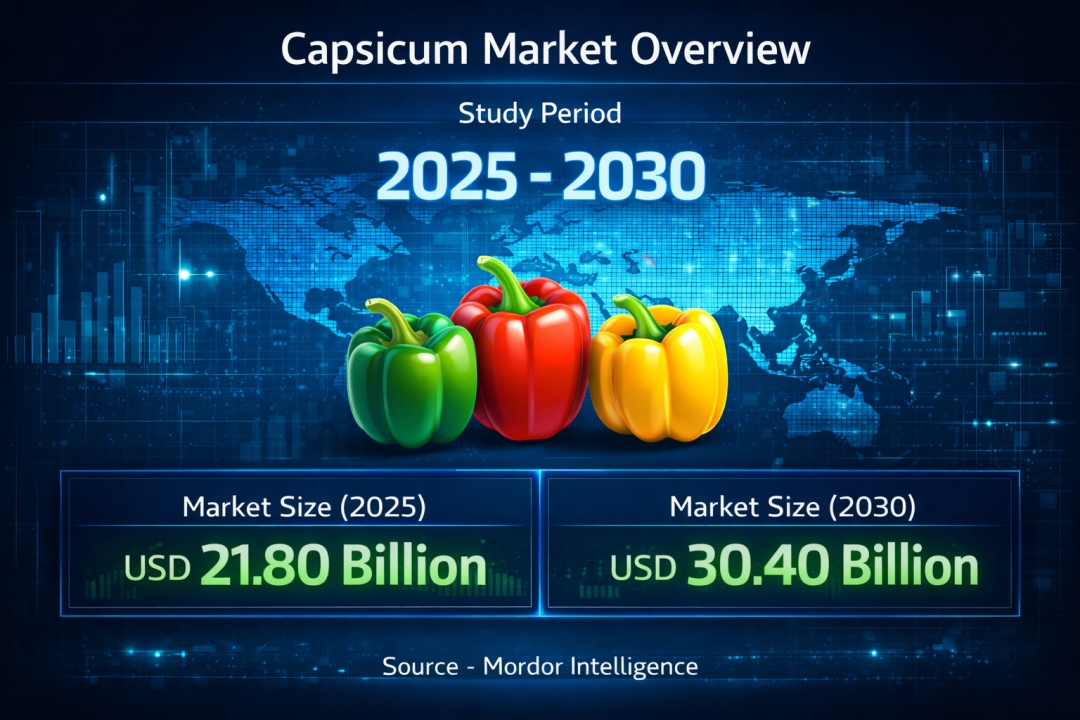
Global Capsicum Market Growth Outlook
According to Mordor Intelligence, the global Capsicum Market size has recorded steady expansion, supported by rising consumption of fresh produce and increasing downstream demand from processed food and nutraceutical industries. The market was valued at USD 21.8 billion in 2024 and is projected to reach USD 30.4 billion by 2030, reflecting consistent growth over the forecast period.
Capsicum, including bell peppers and chili varieties, continues to play a vital role in global diets and functional food formulations. Its nutritional profile, natural pigments, and capsaicin content support demand across culinary, health, and industrial applications. Improved access to controlled-environment farming and digital trade platforms is also strengthening supply reliability and price realization for growers.
Structural Shifts Reshaping the Capsicum Industry
Automation and Protected Farming Improve Yield Stability
One of the most significant developments in the capsicum market industry is the expansion of protected cultivation. High-wire greenhouse systems and automated climate controls are increasingly used to regulate temperature, lighting, and CO₂ levels, reducing labor dependency and improving yield consistency.
Countries such as Canada, the United States, and the Netherlands have adopted year-round controlled-environment cultivation, allowing retailers to maintain a stable supply during off-season periods. These systems also improve fruit quality, supporting premium positioning in export markets.
Functional and Nutraceutical Applications Support Value Growth
Rising demand for capsaicin-based ingredients is strengthening the capsicum market growth outlook. Extracts derived from pungent chili varieties are widely used in pain-relief formulations, dietary supplements, functional beverages, and food additives.
Oleoresin processors and nutraceutical manufacturers increasingly source high-capsaicin varieties, offering price premiums to growers. This trend is shifting parts of the capsicum industry toward higher-value cultivation models rather than volume-driven production alone.
Cluster-Based Controlled Farming Gains Traction
In Southeast Asia and the Middle East, cluster-based farming models are improving smallholder participation in the global capsicum market. Shared infrastructure for irrigation, storage, and quality testing enables producers to improve consistency while reducing operational costs.
The use of IoT-enabled nutrient management and precision irrigation is enhancing yield efficiency while lowering water and pesticide usage. These improvements also help growers comply with international residue limits, strengthening export access and improving capsicum market share in regulated regions.
Capsicum Market Segmentation Snapshot
By Geography:
- Asia-Pacific: Leading producer and consumer, driven by China and India.
- Europe: Focus on high-wire greenhouse technology and premium exports.
- North America: Adoption of automation and controlled-environment systems.
- Africa: Rapidly growing production corridors in Nigeria, Kenya, and Ghana.
- Middle East: Development of agricultural parks supporting smallholders.
- South America: Localized consumption and exports, particularly from Brazil.
By Product Type:
- Fresh capsicum (bell peppers)
- Dried chili and powders
- Oleoresins and capsaicin extracts
By Application:
- Fresh produce consumption
- Processed foods and spices
- Nutraceutical and functional product usage
Other Market Considerations:
- Protected cultivation vs. open-field farming
- Organic and residue-compliant capsicum varieties
- Controlled-environment and cluster-based farming
This segmentation helps stakeholders identify high-value opportunities and plan production strategies that align with consumer demand and international quality standards.
Competitive Landscape and Industry Dynamics
The capsicum market industry includes a mix of multinational agribusinesses, regional producers, and emerging agri-tech-driven growers. Leading participants focus on greenhouse automation, varietal improvement, energy-efficient operations, and compliance with international quality standards.
Export-oriented players benefit from certifications such as GlobalGAP and organic labeling, which remain essential for securing long-term supply contracts. At the same time, smaller producers in Africa, Southeast Asia, and Latin America are scaling production through cluster-based farming and digital trading platforms, improving traceability and market access.
Explore Our Full Library of Agriculture Research Reports- https://www.mordorintelligence.com/market-analysis/agriculture?utm_source=marketersmedia
Capsicum Market Forecast Perspective
The capsicum market forecast points to sustained expansion through 2030, supported by automated protected cultivation, rising nutraceutical demand, and improved supply-chain integration. Asia-Pacific continues to anchor global production, while Africa represents the fastest-growing region due to government support and modernized farming practices.
North America and Europe remain innovation hubs, driven by technology-led cultivation, energy-efficient greenhouses, and premium exports. As food, health, and functional ingredient demand converge, the global capsicum market remains well positioned for long-term, value-led growth.
Industry Related Reports:
Barley Market- The Barley Market is segmented by type, end-user, nature, and geography, covering feed barley, animal feed, and conventional or organic varieties. The report includes production, consumption, import/export analysis, and price trends across major regions like North America, Europe, and Asia-Pacific.
Get more insights: https://www.mordorintelligence.com/industry-reports/barley-market?utm_source=marketersmedia
Avocado Market Size - The global avocado market reached USD 18.5 billion in 2026 and is projected to grow to USD 27.6 billion by 2031, at a CAGR of 8.3%. Rising consumer demand for healthy fats and versatile culinary uses is driving market expansion.
Get more insights: https://www.mordorintelligence.com/industry-reports/avocado-market?utm_source=marketersmedia
Clove Market Share- The Clove Market is segmented geographically, with analysis of production, consumption, imports, exports, and price trends. Valued at USD 5.7 billion in 2025, it is expected to grow to USD 7.76 billion by 2031 at a CAGR of 5.28%.
Get more insights: https://www.mordorintelligence.com/industry-reports/global-clove-market?utm_source=marketersmedia
Media Contact
Company Name: Mordor Intelligence Private Limited
Contact Person: Jignesh Thakkar
Email:Send Email
Phone: +1 617-765-2493
Address:11th Floor, Rajapushpa Summit, Nanakramguda Rd, Financial District, Gachibowli
City: Hyderabad
State: Telangana 500008
Country: India
Website: https://www.mordorintelligence.com/industry-reports/capsicum-market?utm_source=marketersmedia

