
In an industry historically defined by heavy steel, diesel exhaust, and chaotic logistics, a new standard for operational excellence is taking root. For decades, local waste management operators and dumpster rental businesses have been forced to rely on fragmented systems—whiteboards, sticky notes, and endless group texts—to manage their daily fleets. Today, that analog era is officially being pushed out by a digital platform forged directly in the trenches of a rapidly scaling hauling company.
Todd Atkinson, founder of Pack Mule Dumpsters, built his new software out of pure necessity. He needed a way to manage an 80+ dumpster fleet without drowning in paperwork, text messages, and endless spreadsheets. When the tools he tried didn’t cut it, he decided to build something better. Today, his creation is the platform Todd wishes he had when he started — and it’s built to help other dumpster rental owners grow with way less stress. By productizing his own professional blueprint, Atkinson is offering a transformative solution to the entire industry.
The Administrative Avalanche: Why Scaling a Roll-Off Fleet Hurts
The story of almost every successful service business follows a dangerously predictable arc: initial hustle leads to rapid growth, and rapid growth leads to administrative collapse. Managing ten or twenty roll-off containers is entirely feasible with a standard spiral notebook and a few phone calls. But when a local hauling operation expands into a regional powerhouse, the complexity of the logistics scales exponentially.
Atkinson experienced this "complexity wall" firsthand. As Pack Mule Dumpsters expanded its footprint, acquiring high-capacity 30-yard and 40-yard containers to service major roofing and construction contracts, the back-office operations began to crack under the weight of the company’s success. The sheer mental load of tracking which driver was assigned to which route, identifying which bins were sitting empty at a job site accruing zero revenue, and chasing down unpaid invoices became a staggering bottleneck.
The realization was clear: the barrier to taking the business to the next level was no longer a lack of physical assets or customer demand. The barrier was the complete absence of a digital nervous system capable of handling the high-velocity churn of a massive fleet. Spreadsheets are static. They do not update when a driver gets stuck in traffic, and they certainly do not alert you when a contractor has kept a bin three days past their rental agreement. To survive and scale, the hauling industry requires a dynamic, living logistical map.
Bringing Order to Chaos with Advanced Dumpster Tracking
One of the most expensive leaks in a growing waste management business is "lazy iron"—dumpsters that are sitting empty on a job site, forgotten by the contractor, and ignored by the dispatch desk. Every day a bin sits unutilized is a day of lost revenue. Furthermore, in the chaos of manual dispatching, it is shockingly easy to completely lose track of a high-value asset.
To combat this, modern operations must rely on sophisticated Dumpster Tracking systems. By assigning a unique digital identifier to every single container in the yard, dispatchers and owners can view a live, real-time map of their entire inventory. This eliminates the frantic Friday afternoon phone calls asking drivers, "Do you remember where we dropped the blue 20-yarder last Tuesday?"
This level of monitoring goes beyond simple GPS location. It involves custom statuses tailored to the waste workflow. A dispatcher can instantly see if a bin is "Full," "Empty," "Needs Cleaning," or "Pending Pickup." When an owner has total visibility over their fleet, they can make highly aggressive, confident booking decisions. They know exactly what inventory is returning to the yard tomorrow, which means they can book a new drop-off for that exact same bin the following morning, maximizing the utilization rate of every single asset they own.
The "Operator-First" Blueprint: Software Built in the Trenches
Generic field service applications are typically built by tech developers sitting in climate-controlled offices who have never stepped foot on a muddy construction site or smelled a landfill in the middle of July. They create software that looks great in a boardroom presentation but completely fails to understand the gritty nuances of the hauling world.
Generic software doesn't understand the financial sting of a "dry run" fee when a driveway is blocked by a parked car. It doesn't comprehend the necessity of tracking overweight landfill tickets to bill the customer for the difference. Atkinson flipped this dynamic by offering his own lived experience as a deployable product. By utilizing Bin Boss Dumpster Software, independent haulers are essentially licensing the hard-won operational wisdom of a high-volume business owner.
Every feature, button, and automated workflow within the system represents a real-world problem effectively solved in the field. It allows new and growing owners to completely bypass the expensive "trial and error" phase of scaling their yard. The technology acts as a digital twin of a highly successful fleet commander, absorbing the administrative shockwaves so the owner can focus entirely on high-level strategy and customer acquisition. It is a system built specifically for the people wearing work gloves, not just the people wearing suits.
Automating the Customer Experience from Front to Back
We live in an on-demand economy. Your customers order their dinner, their rides, and their groceries from their smartphones with a few simple taps. They now expect the exact same level of seamless convenience when renting a heavy-duty steel container for a home renovation or a commercial roofing job. If your booking process requires a phone call during specific business hours, you are actively losing revenue to competitors who offer 24/7 online ordering.
Innovative fleet management platforms bridge the gap between a rugged industrial service and a polished e-commerce experience. A customer can visit a hauler's website at midnight, select their desired dumpster size, choose their drop-off date, agree to the terms of service, and pay via credit card.
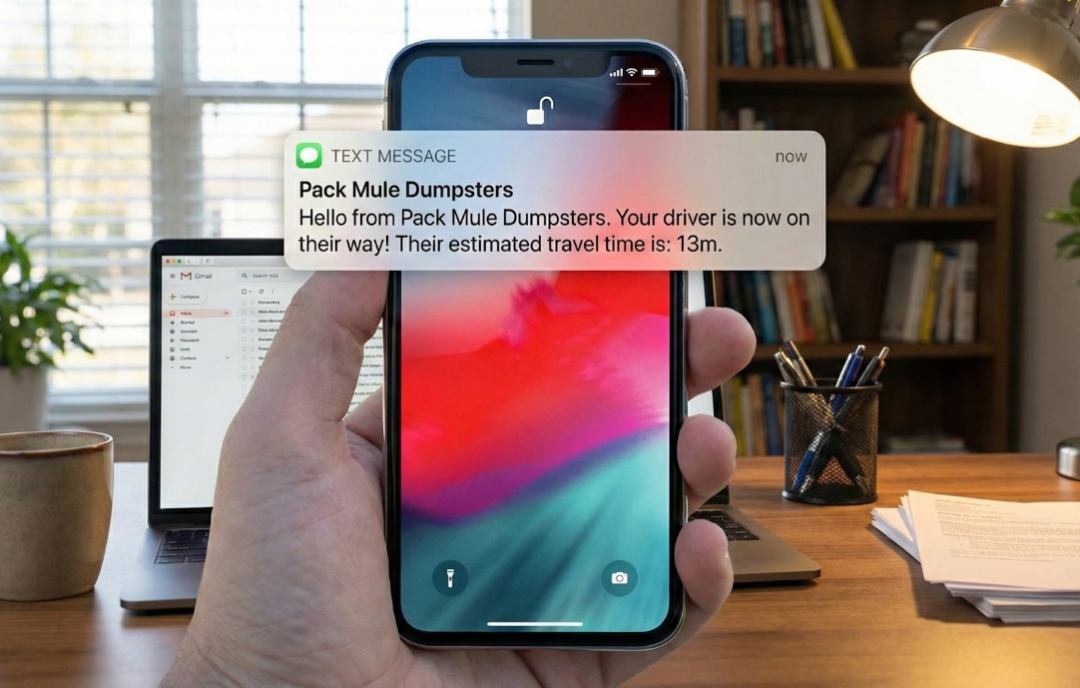
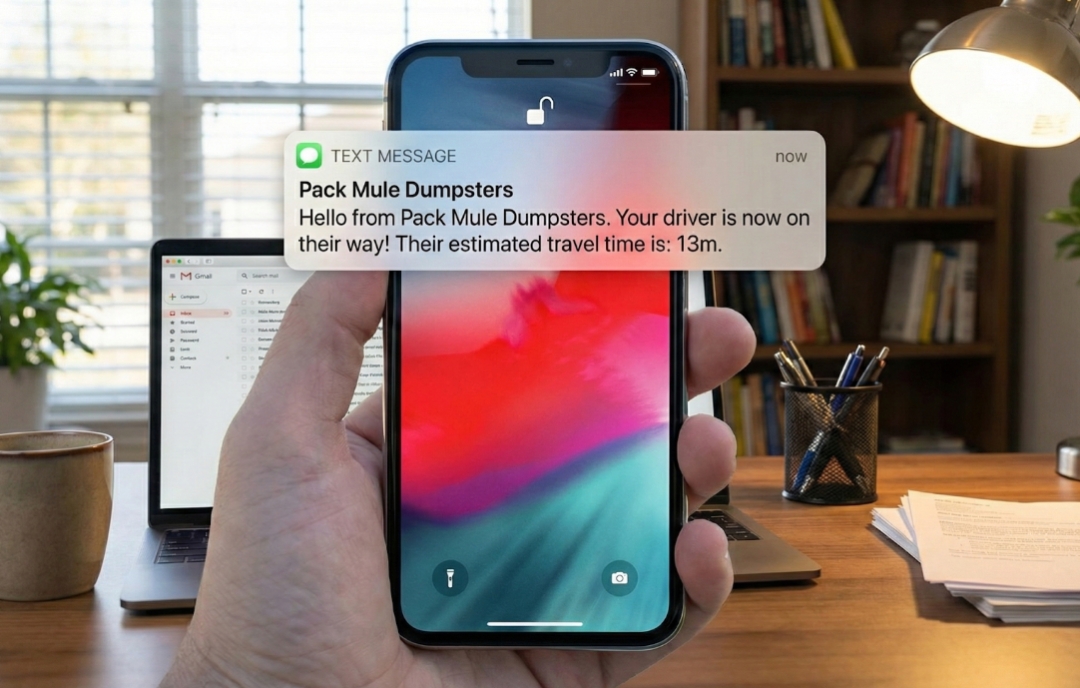
But the automation doesn't stop at the checkout cart. Once the order is placed, the system automatically routes the job to the dispatch board. When the driver is dispatched the next morning, the software sends an automated SMS text message to the customer with a live ETA. When the bin is successfully dropped in the driveway, the driver snaps a photo through their mobile app, which instantly triggers a delivery confirmation email to the client. This proactive communication builds tremendous trust, drastically reduces inbound "Where is my dumpster?" phone calls, and gives a local hauling business the polished, professional sheen of a massive national corporation.
Killing the "Dry Run" and Overage Leaks
In a high-overhead business like roll-off rentals, the difference between a profitable quarter and a deficit often hides in the "administrative leak." This leak consists of unbilled weight overages, lost "dry run" fees, and the labor cost of office staff manually inputting data from paper landfill tickets into an accounting program.
When a driver attempts to deliver a dumpster but the site is inaccessible, the hauling company still burns fuel and pays hourly labor. Without a streamlined digital system, charging the customer for that failed delivery often requires a confrontational phone call and manual invoice generation—a task that is easily forgotten during a busy day.
Purpose-built software completely automates this revenue capture. Using their dedicated mobile app, a driver can instantly flag a blocked site, take a timestamped photo of the obstruction, and trigger an automatic dry-run fee to the customer's card on file. Similarly, when a bin exceeds its allotted tonnage at the landfill, the driver can input the exact weight from the scale ticket directly into the app. The software automatically calculates the overage cost based on the customer's specific contract and generates a supplemental invoice. This ensures that the hauling company never leaves money on the table, aggressively protecting profit margins on every single pull.
Scaling to Legacy Without the Stress Penalty
There is a psychological wall that many dumpster rental owners hit when they reach a certain fleet size. It’s the exhausting feeling that the business owns them, rather than them owning the business. This "growth trap" occurs because manual systems do not scale linearly; they become exponentially more complex and stressful with every new truck and asset added to the fleet.
Technological innovation addresses this psychological burden by providing a scalable, flat-rate framework. A digital platform doesn't care if you are dispatching 8 dumpsters or 800. The underlying process remains exactly the same: the order comes in, the bin is automatically assigned, the driver is notified via their app, and the payment is processed without friction. By offloading the "remembering" to a cloud-based computer system, the human beings running the business are finally free to focus on relationships, fleet maintenance, and big-picture strategy.
This transition is what allows a business owner to move from a frantic survival mindset to a calm legacy mindset. When the paperwork, the late-night text messages, and the chaotic spreadsheets are replaced by a single, unified dashboard, the "stress tax" of business ownership vanishes.
Conclusion: A Frictionless Future for Waste Logistics
The transition from clipboards and static spreadsheets to integrated digital dispatching is no longer just a futuristic concept for the waste management industry—it is the absolute new baseline for survival and success. As Todd Atkinson’s journey with his 80+ fleet proves, you do not have to choose between aggressively growing your business and keeping your personal sanity.
By adopting a platform built out of pure operational necessity by someone who actually understands the daily, gritty grind of hauling, you can automate your administrative busywork, elevate your customer communication to an enterprise level, and capture revenue that used to slip through the cracks. The physical heavy lifting of waste management will always require strong steel and reliable trucks, but coordinating those assets shouldn't feel like a constant, chaotic battle. Embracing this technology means letting the software handle the complex logistics so you can get back to doing what you do best: building a highly profitable, scalable legacy with absolute confidence and way less stress.
Media Contact
Company Name: Bin Boss Dumpster Rental Software
Contact Person: Todd Atkinson
Email:Send Email
Country: United States
Website: https://mybinboss.com/

