
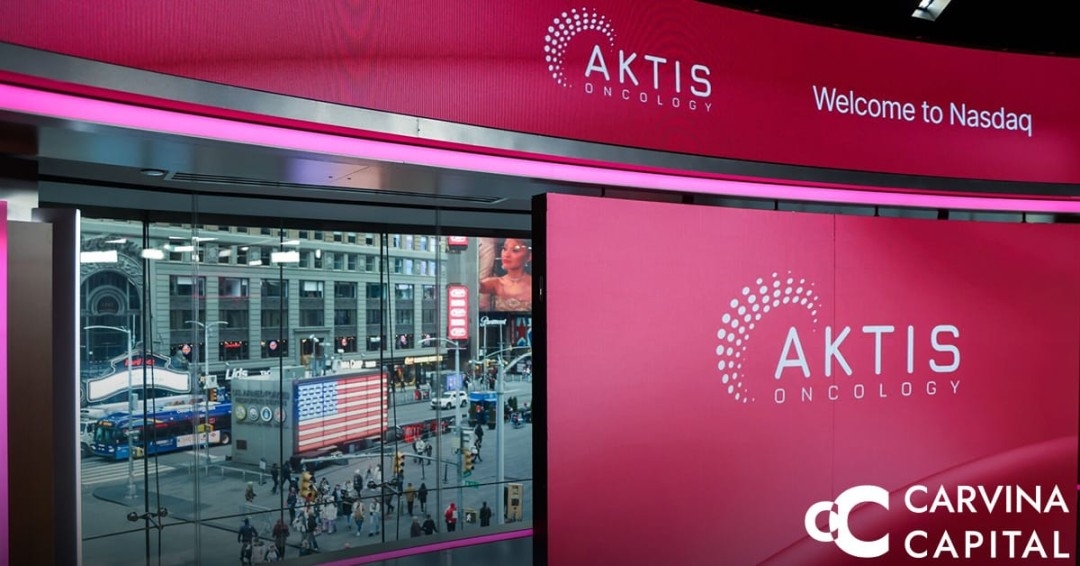
Mid-January is bringing a sharper read on investors’ willingness to fund high-risk science, and Carvina Capital Pte. Ltd. is following the message as Aktis Oncology opens the market for sizeable biotechnology flotations with a radiopharmaceutical listing that tests both price and patience.
The Boston-based, clinical-stage group prices 17.7 million shares at $18 in an offering launched in the first half of January, lifting gross proceeds to about $318 million and putting the implied market value at roughly $950 million at pricing. The final share count expands from an initial plan for about 11.8 million shares marketed at $16 to $18, implying roughly $201 million of proceeds at the top end, a 50% uplift delivered over the bookbuilding period. Trading begins on Nasdaq under the ticker ‘AKTS’, and in the first full session of dealing the shares trade at $22.5, 24.4% above the offer price, a move that “shows institutions are prepared to back specialist platforms when the science is matched by financial discipline”, Peter Jacobs, Director of Private Equity at Carvina Capital.
Eli Lilly commits $100 million to the same issuance, taking close to one-third of the newly issued stock and giving the order book a cornerstone investor with a strategic interest in targeted oncology. The syndicate, led by J.P. Morgan, BofA Securities, Leerink Partners and TD Cowen, is steering a transaction that sits among the three largest biotech new issues of the past 18 months, and the signal is straightforward: “When a major drugmaker writes a cheque of this size at the offer price, it tightens the spread between promise and credibility for everyone else in the book”, Jacobs.
The anchor investment also sits alongside a collaboration agreed over the preceding 12-month period, under which Aktis receives $60 million upfront plus additional equity support, with milestones and royalties that could reach up to $1.2 billion over the life of the programme. The structure matters because radiopharmaceuticals are no longer a niche corner of oncology, and the market increasingly values platforms on whether they can turn technical progress into repeatable development, manufacturing and distribution.
At the centre of the offer is a miniprotein radioconjugate approach, designed to carry alpha-emitting isotopes to malignant cells while limiting exposure to healthy tissue. The proposition is theranostic by design: imaging confirms target engagement, helping clinicians identify patients most likely to benefit and giving investors a clearer line of sight on whether clinical signals can translate beyond specialist nuclear medicine settings.
Carvina Capital highlights the way the clinical plan links science to measurable milestones, with the lead candidate, AKY-1189, targeting Nectin-4, a cell-surface protein expressed across several solid tumours, and the Phase 1b programme set up to enrol about 150 patients over its dose-escalation and expansion phases. Commercial precedent is already visible in the market, with an antibody-drug conjugate aimed at the same pathway generating about $2.4 billion of worldwide revenue over the preceding 12-month period, and the argument is that imaging-led selection could widen access while keeping the risk-reward calculation anchored in data.
A second candidate, AKY-2519, focuses on B7-H3, a target associated with treatment-resistant tumours, and first-in-human work is scheduled within roughly 18 months under current development plans. The listing documents set out a defined tranche of proceeds, about $88.2 million to $100.8 million over the next two years, for advancing that programme through early clinical development.
The wider equity backdrop remains delicate. Over the preceding 12-month period, only 10 biotechnology companies reach public markets, compared with 26 over the 12 months before that, and 93 over a 12-month period during the last cycle’s peak. Aggregate IPO proceeds total about $1.8 billion over the preceding 12 months, a fraction of the roughly $17.7 billion raised over a 12-month peak period, but sentiment improves into the final quarter as the SPDR S&P Biotech ETF rises 33% over the 12 months ending in late December. Rate-cut expectations over the coming quarters are helping, lowering the discount applied to distant revenues.
Radiopharmaceutical dealmaking is underpinning that shift. Major drugmakers commit about $11.1 billion to acquisitions and partnerships in the space over the preceding 12-month period, including a $4.5 billion purchase of RayzeBio, a $2.7 billion deal for Fusion Pharmaceuticals and a $1.6 billion transaction for Point Biopharma. Market forecasts point to the sector expanding from about $10.1 billion in a recent baseline estimate to roughly $29.3 billion over the coming decade, with some projections extending to about $46.5 billion shortly after that.
For Carvina Capital, the lesson from Aktis’ reception is that public markets are reopening selectively, with investors rewarding transparent use of proceeds, credible partnerships and technologies that can be measured as well as marketed. “Risk capital is returning, but it is arriving with a calculator and a timetable”, Jacobs.
About Carvina Capital
Carvina Capital Pte. Ltd. (UEN: 201220825D) is a Singapore-based investment firm founded in 2012. It manages research-led, long-only public equity strategies for institutional and professional clients and is evaluating structures that could broaden access for retail investors. The firm’s approach combines fundamental research with disciplined risk management, aiming to compound capital across full market cycles.
More information is available at https://carvina.com.
Media Contact
Company Name: Carvina Capital Pte. Ltd.
Contact Person: Huacheng Yu
Email:Send Email
Country: Singapore
Website: https://carvina.com

