
Introduction
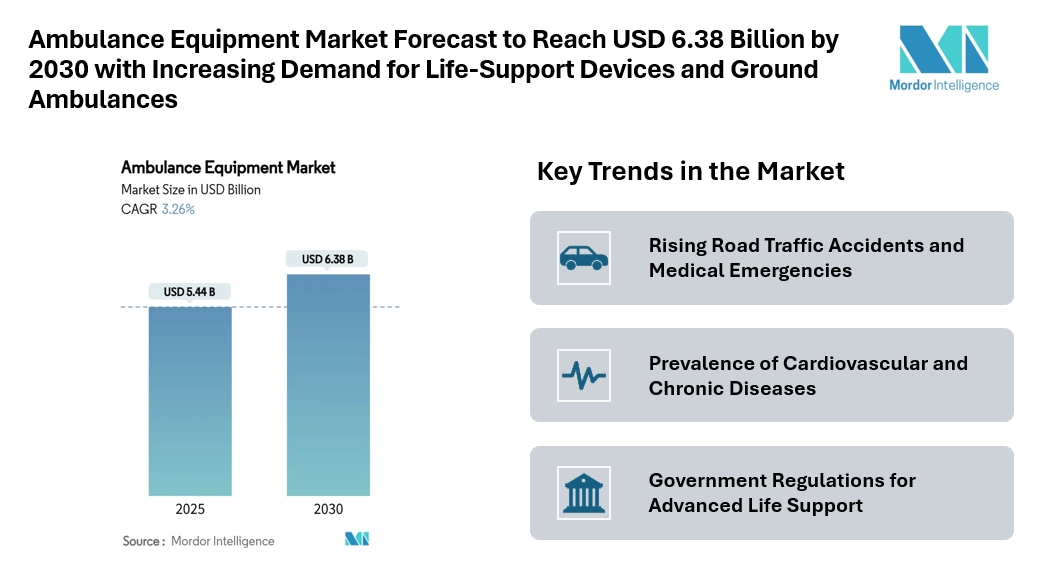
The ambulance equipment market size stands at USD 5.44 billion in 2025 and is forecast to reach USD 6.38 billion by 2030, advancing at a 3.26% CAGR over the period, reflecting a consistent demand for advanced medical equipment in pre-hospital care. This growth is driven by rising road traffic incidents, increasing prevalence of chronic and cardiovascular diseases, and expanding government mandates for advanced life-support standards in ambulances. North America currently dominates the market in terms of share, while the Asia-Pacific region is witnessing the fastest growth due to rapid expansion of emergency medical service infrastructure.
Ambulance equipment plays a critical role in ensuring patient survival during transit to hospitals or trauma centers. From life-support devices to monitoring systems, these products are essential for pre-hospital emergency interventions. The market growth underscores the ongoing need for both replacement cycles in developed regions and first-time procurements in emerging economies.
Key Trends
Several trends are shaping the ambulance equipment market and influencing procurement and innovation strategies:
Rising Road Traffic Accidents and Medical Emergencies
Increasing urbanization and congested road networks have led to a surge in emergency calls, intensifying the demand for well-equipped ambulances. Governments and EMS providers are prioritizing equipment that can improve response times and patient outcomes.
Prevalence of Cardiovascular and Chronic Diseases
The global rise in chronic health conditions such as heart disease has prompted a higher requirement for defibrillators, ventilators, and other life-support devices in ambulances. Pre-hospital interventions have become a key focus for improving survival rates.
Government Regulations for Advanced Life Support
In several countries, including North America and parts of Europe, governments are enforcing stricter guidelines for ambulance equipment, particularly in terms of advanced life-support capabilities. These regulations are pushing EMS providers to upgrade their fleets with modern devices.
Miniaturization and Connectivity of Medical Devices
Smaller, portable, and connected devices are becoming increasingly popular as they allow paramedics to deliver hospital-level care in transit. Device connectivity enables real-time patient monitoring and data sharing with hospitals, enhancing decision-making.
Market Segmentation
The ambulance equipment market is segmented by product type, vehicle type, life-support level, end user, and geography. Key segments include:
Product Type
-
Life Support & Emergency Resuscitation Equipment
-
Patient Monitoring Equipment
-
Patient Handling & Transport Equipment
-
Respiratory & Airway Management Devices
-
Infection-Control & Consumables
Vehicle Type
-
Ground Ambulances
-
Air Ambulances
-
Water Ambulances
Life Support Level
-
Basic Life Support (BLS) Equipment
-
Advanced Life Support (ALS) Equipment
End User
-
Hospitals & Trauma Centres
-
Emergency Medical Service (EMS) Providers
-
Military & Defence Agencies
-
Ambulatory Surgical Centres & Others
By Geography
-
North America
-
South America
-
Middle east & Africa
-
Europe
-
Asia pacific
This segmentation highlights the areas where ambulance equipment market growth is concentrated and where investment opportunities may be strongest.
Key Players
The ambulance equipment market consists of several established players and emerging companies providing a wide range of emergency medical devices. Major market participants focus on delivering reliable, efficient, and connected solutions for pre-hospital care. These companies operate across multiple regions, supplying equipment to hospitals, EMS providers, and private ambulance operators. The competitive environment encourages continuous product development and adoption of newer technologies, particularly in monitoring and life-support systems.
-
Stryker Corporation
-
GE HealthCare
-
Drägerwerk AG & Co. KGaA
-
Philips Healthcare
-
Medtronic plc
Conclusion
The ambulance equipment market is steadily advancing, driven by increasing medical emergencies, chronic disease prevalence, and government regulations mandating advanced life-support standards. North America maintains a stronghold in market share, while Asia-Pacific’s rapid EMS expansion presents new growth opportunities. Key trends such as miniaturization, connectivity of devices, and low-emission equipment are shaping procurement strategies and influencing the overall ambulance equipment market analysis.
Industry Related Reports:
Medical Protective Equipment Market: The Medical Protective Equipment market is segmented based on product, usability, end user, and geography. By product, the market includes surgical masks, N95 respirators, gloves, gowns, face shields, and other protective items. In terms of usability, it is categorized into disposable and reusable equipment. The end-user segment covers hospitals and clinics, ambulatory surgical centers, diagnostic laboratories, and other healthcare facilities. Geographically, the market spans North America, Europe, Asia-Pacific, the Middle East and Africa, and South America.
Emergency Medical Services Products Market: The Emergency Medical Services (EMS) Products Market is categorized based on product type, including life support and emergency resuscitation equipment, patient monitoring systems, and other related products. It is further segmented by application, covering areas such as cardiac care, trauma and injury management, among others. The market also considers end users, including hospitals, trauma centers, and other healthcare facilities, and is analyzed across key regions, including North America, Europe, Asia-Pacific, the Middle East & Africa, and South America.
Ambulance Stretchers Market: The Ambulance Stretchers Market is analyzed across various segments, including product types such as transport stretchers, emergency stretchers, bariatric stretchers, and others. The market is also categorized by technology, encompassing manual, electric-powered, hydraulic/pneumatic, and additional variants. Key end-users include hospitals and trauma centers, EMS providers, military and disaster relief agencies, among others. Furthermore, the market is examined geographically, covering regions such as North America, Europe, Asia Pacific, and beyond.
About Mordor Intelligence:
Mordor Intelligence is a trusted partner for businesses seeking comprehensive and actionable market intelligence. Our global reach, expert team, and tailored solutions empower organizations and individuals to make informed decisions, navigate complex markets, and achieve their strategic goals.
With a team of over 550 domain experts and on-ground specialists spanning 150+ countries, Mordor Intelligence possesses a unique understanding of the global business landscape. This expertise translates into comprehensive syndicated and custom research reports covering a wide spectrum of industries, including aerospace & defense, agriculture, animal nutrition and wellness, automation, automotive, chemicals & materials, consumer goods & services, electronics, energy & power, financial services, food & beverages, healthcare, hospitality & tourism, information & communications technology, investment opportunities, and logistics.
For any inquiries or to access the full report, please contact:
media@mordorintelligence.com https://www.mordorintelligence.com/
Media Contact
Company Name: Mordor Intelligence Private Limited
Contact Person: Mordor Intelligence
Email:Send Email
Phone: +1 617-765-2493
Address:11th Floor, Rajapushpa Summit, Nanakramguda Rd, Financial District, Gachibowli
City: Hyderabad
State: Telangana 500008
Country: United States
Website: https://www.mordorintelligence.com/

