
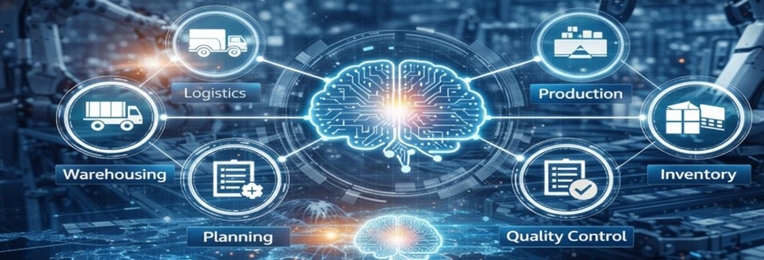
As manufacturing and life sciences supply chains continue to face operational disruptions, fluctuating demand patterns, and increasing complexity, organizations are increasingly integrating artificial intelligence into enterprise operational systems. These intelligent technologies enable organizations to analyze operational data more effectively, anticipate disruptions, and improve overall supply chain resilience.
Enterprise supply chains generate significant volumes of real-time operational data, including production activity, inventory levels, and logistics conditions. Artificial intelligence-enabled systems allow organizations to process this data and generate predictive insights that support more informed planning and operational decision-making. These capabilities are particularly important in regulated manufacturing sectors such as life sciences, where production continuity, quality assurance, and traceability are essential.
Professionals working at the intersection of enterprise systems and artificial intelligence are playing an important role in enabling this transition. Among them is Ankit Sharma, a U.S. based enterprise systems specialist whose work focuses on enabling intelligent supply chain systems capable of supporting predictive operational decision-making in complex manufacturing environments.
Sharma’s work involves designing enterprise operational architectures that integrate predictive analytics and real-time operational data, enabling organizations to improve planning accuracy, enhance production visibility, and reduce operational disruptions. These systems allow supply chain and manufacturing teams to identify emerging risks earlier and respond more effectively to changing operational conditions.
Enabling Predictive and Adaptive Supply Chain Operations
Traditional enterprise supply chain systems have primarily focused on recording operational transactions and supporting static planning processes. While these systems provide essential operational visibility, they often rely on reactive decision-making models that limit organizations’ ability to anticipate disruptions or adjust operational strategies dynamically.
Artificial intelligence enabled enterprise systems represent an important advancement, allowing organizations to continuously analyze operational conditions and generate predictive insights that improve operational planning and execution.
Dr. Maria, Executive Director of the MIT Supply Chain Management Program, noted that integrating artificial intelligence into enterprise supply chain systems enables organizations to transition from reactive operational models toward predictive and adaptive decision-making capabilities, strengthening supply chain resilience and improving operational reliability.
Industry observers note that predictive enterprise systems allow organizations to improve resource planning, reduce operational inefficiencies, and enhance supply chain continuity. These capabilities are particularly valuable in life sciences manufacturing, where even minor operational disruptions can affect production timelines and supply availability.
Supporting the Evolution of Intelligent Life Sciences and Industrial Manufacturing Systems
Life sciences and advanced manufacturing operations rely on tightly integrated supply chain systems to maintain production continuity and ensure product availability.
Enterprise supply chain systems capable of analyzing operational data and supporting predictive planning allow organizations to improve production coordination and reduce the risk of operational disruptions.
Professionals involved in designing and implementing intelligent enterprise systems contribute to advancing manufacturing resilience by enabling more adaptive and data- driven operational models. These systems support improved coordination across production, inventory, and logistics operations, helping organizations respond more effectively to changing operational conditions.
As artificial intelligence technologies continue to mature, their integration into enterprise supply chain systems is expected to play an increasingly important role in improving manufacturing reliability, operational efficiency, and supply chain continuity across regulated industries such as life sciences.
Supporting the Strengthening of U.S. Life Sciences and Manufacturing Supply Chains
The strengthening of domestic supply chain and manufacturing infrastructure has become a growing priority for U.S. industries, particularly as organizations seek to improve operational resilience and reduce vulnerabilities in production and distribution networks. Artificial intelligence-enabled enterprise systems are increasingly viewed as an important component of improving supply chain visibility, operational reliability, and manufacturing continuity.
Enterprise systems capable of analyzing operational data and supporting predictive decision-making allow organizations to identify potential disruptions earlier and improve coordination across production, inventory, and distribution operations. These capabilities help organizations enhance supply chain stability and maintain reliable manufacturing operations.
Sharma’s work in enabling predictive and intelligence-driven enterprise supply chain systems reflects broader efforts to improve operational resilience and support modern life sciences and industrial manufacturing environments. By enabling enterprise systems to generate predictive operational insights and improve planning accuracy, such contributions support more reliable and adaptive supply chain operations.
Industry analysts note that continued advancement of intelligent enterprise supply chain systems will play an important role in improving the efficiency, reliability, and resilience of manufacturing and supply chain operations across critical sectors of the U.S. economy.
Growing Role of Enterprise System Specialists in Intelligent Supply Chains
The adoption of artificial intelligence in supply chain operations reflects a broader shift toward data-driven enterprise decision-making. Organizations across life sciences and advanced manufacturing sectors are increasingly seeking to improve operational performance, enhance resilience, and enable more adaptive responses to supply chain disruptions.
Professionals contributing to the design and implementation of intelligent enterprise systems are helping organizations transition toward predictive supply chain models capable of supporting modern manufacturing requirements.
As enterprise supply chain systems continue to evolve, artificial intelligence-driven operational intelligence is expected to play an increasingly important role in enabling resilient, efficient, and adaptive manufacturing and supply chain systems.
Media Contact
Company Name: theleanx
Email:Send Email
Address:103 Alkapuri
City: Dewas
State: Madhya Pradesh 455001
Country: India
Website: https://theleanx.com/

