
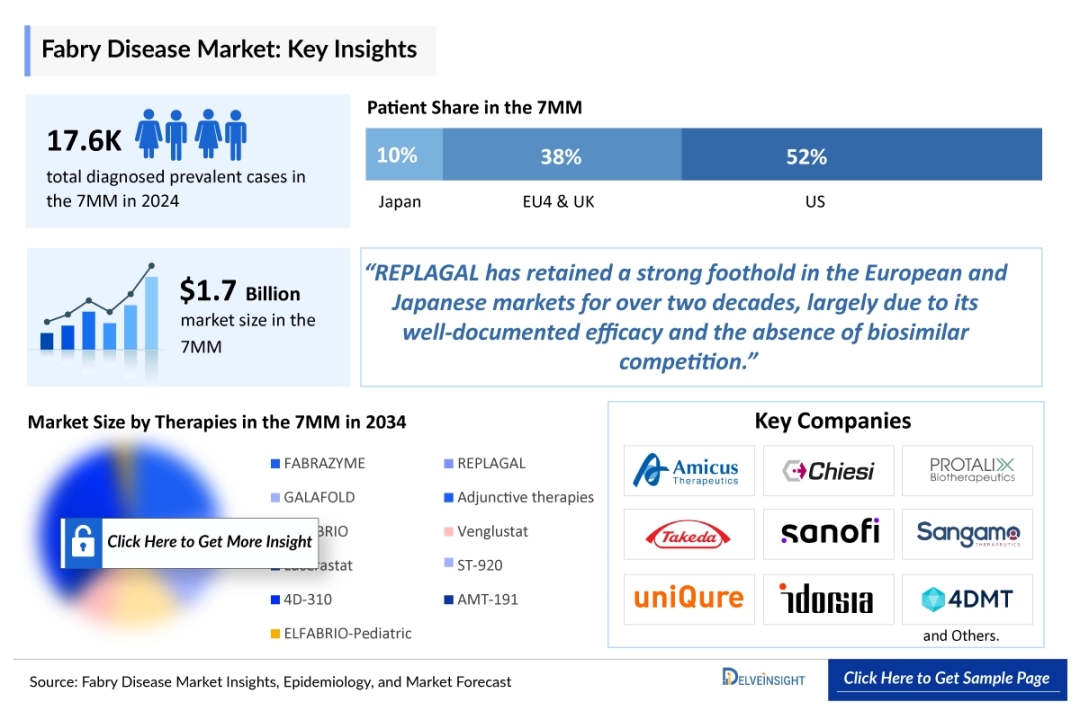
DelveInsight estimates that the Fabry Disease market reached a value of USD 1.7 billion in 2024. In the same year, the United States led the Fabry Disease therapeutics market, accounting for approximately 52% of the total 7MM market and generating close to USD 880 million—the largest share across all regions. The market is anticipated to witness robust growth through 2034. Fabry disease is a rare X-linked genetic disorder caused by mutations in the alpha-galactosidase A gene, resulting in progressive damage to multiple organs. While advances in newborn screening programs are enabling earlier diagnosis, a significant proportion of adults continue to experience severe disease-related complications by mid-life.
Currently available treatment options for Fabry disease include enzyme replacement therapies (ERTs) and pharmacological chaperone therapy. Prominent marketed therapies—FABRAZYME, REPLAGAL, GALAFOLD, and ELFABRIO—utilize different mechanisms to address the underlying enzyme deficiency. In the US, FABRAZYME remains the most widely used ERT, whereas REPLAGAL has a strong foothold in Europe and Japan. ELFABRIO, the most recent market entrant, has received approval in both the US and EU, with ongoing regulatory efforts aimed at enabling a monthly dosing schedule.
The competitive landscape comprises leading pharmaceutical and biotechnology companies such as Amicus Therapeutics, Sanofi (Genzyme), Takeda, CHIESI–Protalix, Sangamo Therapeutics, and uniQure. The development pipeline includes several promising assets, including Venglustat, the gene therapy candidate ST-920, and additional therapies such as lucerastat, 4D-310, and AMT-191—although some candidates have encountered efficacy or safety-related challenges. Other early-stage therapies, including AceLink’s AL01211, are also demonstrating initial promise.
Continued progress in clinical research, rapid innovation in gene therapies, increasing disease awareness, and improvements in diagnostic capabilities are expected to fuel future market expansion and enhance patient outcomes in Fabry disease.
DelveInsight’s report, “Fabry Disease Market Insights, Epidemiology, and Market Forecast – 2034,” provides a comprehensive overview of Fabry disease, covering historical and projected epidemiology as well as market trends across the United States, EU5 (Germany, Spain, Italy, France, and the United Kingdom), and Japan. The report analyzes current treatment standards, emerging therapies, individual therapy market shares, and both historical and forecasted market size from 2020 to 2034 across the seven major markets. Additionally, it evaluates existing treatment algorithms, key market drivers, barriers, and unmet needs to identify growth opportunities and assess the overall potential of the Fabry Disease market.
Request for a Free Sample Report @ Fabry Disease Market Forecast
Key Highlights from the Fabry Disease Market Report
- According to DelveInsight, the Fabry Disease market is projected to expand at a steady CAGR through 2034.
- DelveInsight analysis indicates that the total Fabry Disease market size across the 7MM was approximately USD 1.7 billion in 2024.
- In 2022, the diagnosed prevalent population of Fabry disease across the 7MM stood at around 15,290 cases, with numbers expected to rise throughout the forecast period (2019–2034).
- Major companies operating in the Fabry Disease market include Protalix Biotherapeutics, Sanofi Genzyme, Sangamo Therapeutics, Freeline Therapeutics, 4D Molecular Therapeutics, Idorsia Pharmaceuticals, GREENOVATION BIOTECH GMBH, Shire, Takeda, Amicus Therapeutics, uniQure, Codexis, MP6 Therapeutics, CellGenTech, and others.
- Key therapies anticipated to enter the market include PRX-102 (Pegunigalsidase alfa), Venglustat, ST-920, FLT190, 4D-310, Lucerastat, Moss-aGal, among others.
- May 2025: All patients treated with Sangamo Therapeutics’ gene therapy ST-920 (isaralgagene civaparvovec) in the Phase 1/2 trial reached the FDA-mandated one-year follow-up milestone, enabling progression toward accelerated approval. Sangamo expects pivotal data by the end of June, and the FDA has previously indicated that Phase 1/2 STAAR trial data may be sufficient for accelerated approval, potentially bypassing additional trials.
- March 2025: Sangamo Therapeutics confirmed alignment with the FDA on an accelerated approval pathway for ST-920, with plans to submit a BLA in the second half of 2025.
- February 2025: Amicus Therapeutics showcased oral presentations and posters on its migalastat development programs at the 21st Annual WORLD Symposium.
- January 2025: Idorsia Pharmaceuticals announced expectations for Phase III Open-Label Extension study results in Q2 2025, followed by discussions with the US FDA on the regulatory pathway.
- January 2025: Sanofi disclosed that regulatory submission for venglustat in Fabry disease is targeted for 2026.
- December 2024: CHIESI Farmaceutici and Protalix BioTherapeutics reported EMA validation of a variation application for pegunigalsidase alfa, supporting a less frequent dosing regimen of 2 mg/kg every four weeks in adult Fabry patients.
- September 2024: uniQure stated that its Phase I/IIa gene therapy program is expected to generate initial proof-of-concept data in 2025.
- March 2024: Sanofi released Phase IV study results assessing the safety and tolerability of Fabrazyme at higher infusion rates and reduced volumes.
- April 2024: 4D Molecular Therapeutics announced results from an open-label Phase 1/2a study of gene therapy 4D-310 in adults with Fabry disease and cardiac involvement.
Fabry Disease Overview
Fabry disease is a rare X-linked lysosomal storage disorder caused by pathogenic variants in the GLA gene, leading to reduced activity of the α-galactosidase A enzyme. This deficiency results in the accumulation of globotriaosylceramide (Gb3) in multiple organs, particularly the kidneys, heart, and nervous system. Clinical manifestations range from neuropathic pain, heat intolerance, angiokeratomas, and gastrointestinal symptoms to severe complications such as renal failure, cardiomyopathy, arrhythmias, and stroke. Although both males and females are affected, disease severity varies, with late-onset forms being more prevalent and often diagnosed during adulthood. Expanded newborn screening and genetic testing are improving early detection. Current treatments include ERTs such as FABRAZYME and REPLAGAL, as well as the oral chaperone therapy GALAFOLD, all aimed at reducing substrate accumulation and slowing disease progression. Emerging therapies, including substrate reduction approaches and gene therapies, offer the potential for more durable and targeted disease control.
Learn more about Fabry Disease treatment algorithms in different geographies, and patient journeys. Contact to receive a sample @ Fabry Disease Drugs Market
Fabry Disease Market Outlook
The Fabry Disease therapeutics market across the 7MM was valued at approximately USD 1.7 billion in 2024, with the United States accounting for nearly 52% (around USD 880 million) of total revenue. Europe followed, led by Germany (approximately USD 210 million), while Spain represented the smallest share (around USD 82 million). Japan contributed nearly USD 150 million, or about 9% of the total market.
Fabry disease arises from α-Gal A enzyme deficiency, leading to progressive organ damage. Available treatments include ERTs—FABRAZYME, REPLAGAL, and ELFABRIO—and the oral chaperone therapy GALAFOLD, which is effective in roughly 35–50% of patients with amenable GLA mutations. While ERTs remain the backbone of therapy, challenges such as frequent intravenous infusions and the development of antidrug antibodies persist.
Emerging therapies, including venglustat, ST-920, 4D-310, and AMT-191, aim to enhance enzyme delivery and introduce gene-based treatment options. Market growth is being driven by rising prevalence, improved diagnostic rates, and pipeline innovation, although pediatric treatment gaps and long-term durability remain key concerns.
Fabry Disease Market Drivers
- Growing Awareness and Early Diagnosis: Expanded newborn screening and greater awareness are enabling earlier identification and treatment.
- Limited Approved Therapies: A small number of existing treatment options creates strong demand for more effective alternatives.
- Pipeline Advancement: Innovation in next-generation ERTs, SRTs, and gene therapies is broadening therapeutic possibilities.
- Regulatory Progress: Approvals and label expansions for therapies such as ELFABRIO and GALAFOLD support market expansion.
- High Unmet Medical Need: Ongoing organ damage and disease complications drive demand for therapies that improve survival and quality of life.
Fabry Disease Market Barriers
- High Cost of Treatment: Expensive therapies pose access and reimbursement challenges.
- Complex Clinical Management: Phenotypic variability and late-onset disease complicate treatment decisions.
- Lack of Curative Options: Current treatments are disease-modifying rather than curative; gene therapies remain investigational.
- Clinical Development Risks: Some pipeline assets have faced setbacks related to safety or efficacy.
- Small Patient Population: Limited prevalence can restrict commercial scalability and R&D investment.
Fabry Disease Epidemiology
In 2024, the United States accounted for approximately 9,200 diagnosed prevalent Fabry disease cases, representing nearly 52% of the total 7MM population. The EU4 and the UK together comprised about 38%, while Japan contributed roughly 10%. Germany reported the highest number of diagnosed cases in Europe (~2,170), whereas Spain had the lowest.
In the US, late-onset Fabry disease predominated, with around 5,860 cases, compared to approximately 3,300 classic cases. By age group, prevalence peaked among individuals aged 10–19 years (~1,920 cases), followed by 20–29 years (~1,780), 30–39 years (~1,700), and 40–49 years (~1,430), with about 1,180 cases each in those under 10 years and over 50 years. These patterns highlight the dominance of late-onset disease and underscore the importance of early diagnosis and timely intervention.
Fabry Disease Epidemiology Segmentation
- Total diagnosed prevalent cases
- Gender-specific diagnosed prevalent cases
- Age-specific diagnosed prevalent cases
- Phenotype-specific diagnosed prevalent cases
Explore more about Fabry Disease Epidemiology @ Fabry Disease Patient Pool Forecasting
According to DelveInsight, Fabry disease prevalence is higher in males than females across the 7MM, although regional variations exist.
Fabry Disease Competitive Landscape (Paraphrased)
- Venglustat (Sanofi/Genzyme): An oral substrate reduction therapy designed to inhibit glucosylceramide synthase, reducing glycosphingolipid accumulation. Late-stage development is ongoing, with Phase III data expected in H2 2025 and potential regulatory submissions in 2026.
- Lucerastat (Idorsia): A small-molecule SRT applicable across Fabry phenotypes. Although the Phase III MODIFY trial missed its primary endpoint, long-term OLE data expected in Q2 2025 may support its future role. The therapy holds orphan designation in the US and EU.
- ST-920 (Sangamo Therapeutics): A liver-targeted AAV2/6 gene therapy enabling sustained α-Gal A production following a single IV dose. Encouraging safety and durability data support ongoing accelerated approval discussions, with a BLA planned for H2 2025.
- AMT-191 (uniQure): An AAV5-based gene therapy designed for long-term correction of α-Gal A deficiency. Early-stage trials are progressing, with FDA orphan and fast-track designations supporting expedited development.
Request for a sample report to understand more about the Fabry Disease pipeline development activities @ Fabry Disease Clinical Trials and FDA Approvals
Fabry Disease Pipeline Therapies & Key Companies
- PRX-102 (Pegunigalsidase alfa): Protalix Biotherapeutics
- Venglustat: Sanofi Genzyme
- ST-920: Sangamo Therapeutics
- FLT190: Freeline Therapeutics
- 4D-310: 4D Molecular Therapeutics
- Lucerastat: Idorsia Pharmaceuticals
- Moss-aGal: GREENOVATION BIOTECH GMBH
Fabry Disease Therapeutics Assessment
Numerous companies are actively advancing innovative therapies in the Fabry Disease market, including Protalix Biotherapeutics (NYSE: PLX), Sanofi Genzyme (EPA: SAN), Sangamo Therapeutics (NASDAQ: SGMO), Freeline Therapeutics (NASDAQ: FRLN), 4D Molecular Therapeutics (NASDAQ: FDMT), Idorsia Pharmaceuticals (SWX: IDIA), GREENOVATION BIOTECH GMBH, Shire (formerly NASDAQ: SHPG), Takeda (TSE: 4502), Amicus Therapeutics (NASDAQ: FOLD), uniQure (NASDAQ: QURE), Codexis (NASDAQ: CDXS), MP6 Therapeutics, CellGenTech, Protalix (NYSE: PLX) and others.
Learn more about the emerging Fabry Disease therapies & key companies @ Fabry Disease Treatment Market
Fabry Disease Report Key Insights
- Patient population analysis
- Market size and growth trends
- Competitive dynamics
- Market drivers and barriers
- Emerging opportunities
- Therapeutic strategies
- Pipeline evaluation
- Current treatment algorithms
- Impact of emerging therapies
About DelveInsight
DelveInsight is a premier life sciences market research and business consulting firm, widely recognized for its syndicated research reports and customized solutions tailored to the healthcare industry.
Media Contact
Company Name: DelveInsight Business Research LLP
Contact Person: Ankit Nigam
Email:Send Email
Phone: +14699457679
Address:304 S. Jones Blvd #2432
City: Albany
State: New York
Country: United States
Website: https://www.delveinsight.com/consulting/conference-coverage-services

