
Keeping our homes safe depends a lot on how safely we use electricity. Today, every household uses appliances like air conditioners, fridges, washing machines, and TVs. Because of this, it’s very important to make sure our electrical load is safe.
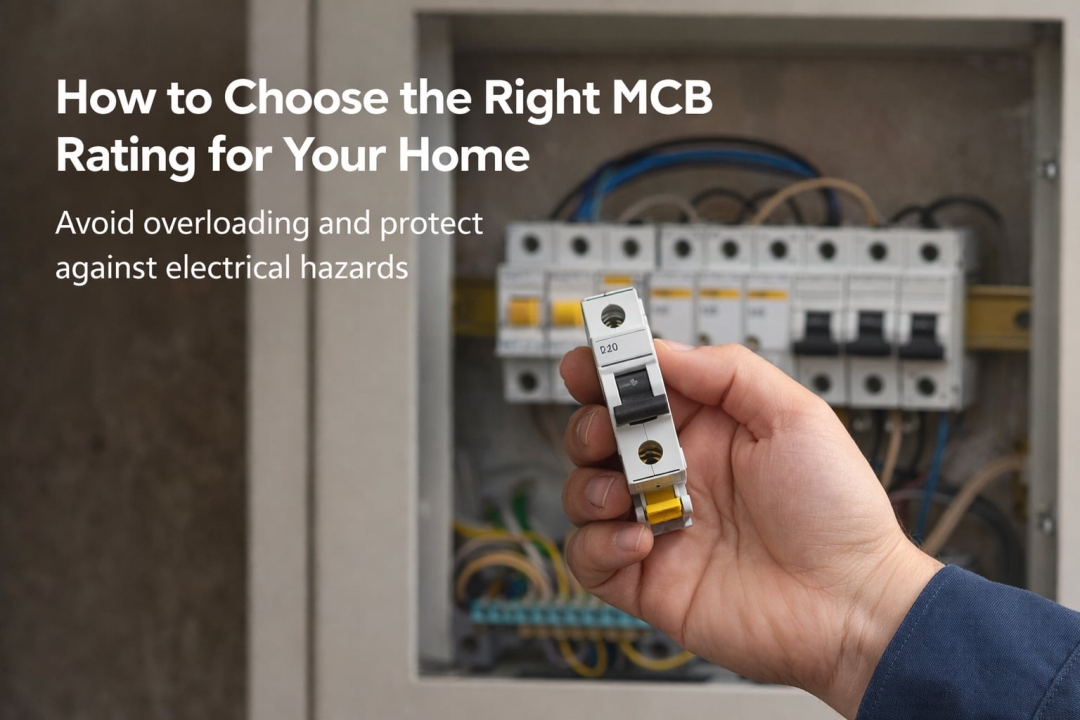
One of the key devices that protects our home wiring is the Miniature Circuit Breaker (MCB). It helps prevent damage by switching off the power automatically if there is too much load or a fault in the system.
MCBs are used to protect electrical circuits and automatically break the circuit when unusual current conditions are detected. This is vital when choosing an MCB (Miniature Circuit Breaker) because an improperly rated breaker may either cause nuisance tripping or fail to trip during an overload.
Understanding the working principle of a mini circuit breaker and knowing how to select the right one can help create superior electrical systems at home that are safer and more effective.
What Is a Miniature Circuit Breaker?
A Miniature Circuit Breaker (MCB) is an automatically operated electromechanical switching device that protects electrical cables and circuits against overloads and short circuits.
The breaker comes into play when the current through a circuit rises above the maximum permissible current; then the breaker operates and de-energises the circuit.
With MCBs, one can reset them and reuse them, unlike in traditional fuse systems, where the fuse must be replaced once the fault has been cleared. This makes them useful and dependable for residential electrical protection.
MCBs are fitted on various circuits inside a standard home distribution board, including lighting, power outlets, kitchen appliances, and air conditioning. Every breaker will serve a power line, ensuring that failure in one part of the house will not affect the rest of the house.
This concept is known as selective coordination (discrimination), ensuring only the faulty circuit trips while power supply continues to other circuits.
Why Choosing the Correct MCB Rating Matters
The current limit per mini circuit breaker is set by the circuit breaker's rating. It is necessary to select the appropriate rating, whether it is safety or operational stability.
The breaker rating must not be too low, or it will hunt frequently under normal working conditions. On the other hand, with a rating that is too high, the breaker cannot shut off current in the event of an overcurrent, which may lead to excessive heat or a fire. Electrical protection in MCBs is necessary in order to guarantee:
- Reliable circuit protection
- Reduced risk of electrical fires
- Longer lifespan of wiring and appliances
- Stable power supply for household devices
MCB selection should also consider conductor cross-section (sq.mm), installation method, ambient temperature, and prospective short-circuit current at the distribution board, typically aligned with IS/IEC standards.
How MCBs Protect Home Circuits
MCBs are designed to respond to two common electrical faults: overload and short circuit conditions. In an overload situation, the current in the circuit gradually increases beyond its safe capacity. The thermal protection mechanism inside the mini MCBs responds to the increased temperature and eventually trips the breaker.
When short-circuiting occurs, the current abruptly increases to very high values. This sudden surge is detected by the magnetic trip mechanism, disconnecting the circuit almost instantly. MCBs can be used to protect residential electrical circuits due to their protective characteristics.
Understanding Different MCB Ratings
MCB ratings are typically defined by the maximum current they can carry continuously without tripping. Residential circuits usually require different ratings depending on the connected load. Common MCB ratings used in homes include:
- Typically 6A for lighting circuits
- 16A for general-purpose outlets (common)
- 20- 25A for dedicated heavy loads with matching conductor sizes and breakers
Mini circuit breakers must be selected based on the electrical load they are expected to withstand in the circuit. For example, lighting circuits do not normally require high current-carrying capacity, whereas appliances like air conditioners may require MCBs with higher current-carrying capacity.
Types of MCB Trip Curves Used in Homes
Another important factor when selecting a miniature circuit breaker MCB is the trip curve. Trip curves determine how quickly the breaker responds to different levels of overcurrent. Common trip curve types include:
- Type B (3-5× In): Designed for resistive loads, low inrush (lighting, sockets)
- Type C (5-10× In): Designed for moderate inrush (motors, ACs, refrigerators). These are often used in homes for motor-starting loads
- Type D (10-20× In): Designed for high inrush (transformers, large motors). These are typically industrial and must be avoided in residences unless justified.
Type B or Type C breakers are used in most homes with MCB-protected circuits, depending on the attached appliances. Depending on appliance inrush, homes may mix Type B and Type C. The proper choice of the trip curve can be used to achieve the desired result, where the breaker will not trip excessively without sufficient protection.
Factors to Consider When Selecting MCBs for Home
Choosing the correct mini MCB requires careful evaluation of several factors within the home electrical system. Important considerations include:
- Total load connected to the circuit
- Type of electrical appliances used
- Wiring capacity of the circuit
- Short circuit protection requirements
- Distribution board configuration
Additionally, electricians must verify that the MCB breaking capacity (Icu/Ics in kA) is equal to or higher than the available fault current at the installation point. By considering these factors, electricians can select the appropriate mini circuit breaker to ensure safe, reliable operation.
Role of MCBs in Home Distribution Boards
The distribution board is typically installed in home electrical systems and has several MCBs. The breakers protect the specific circuit in the house. Examples of typical circuit schemes that are safeguarded by MCBs are:
- Lighting circuits
- Power socket circuits
- Kitchen appliances
- Air conditioning units
- Water heaters
This selective coordination ensures only the affected circuit trips, preserving supply to others. The selective protection prevents complete power loss within the home.
Advantages of Using Miniature Circuit Breakers
The popularity of the Miniature Circuit Breaker in residential systems stems from its many advantages over older protection devices. Some key benefits include:
- Reliable overload and short circuit protection
- Easy reset after fault clearance
- Long operational lifespan
- Improved safety compared to fuse systems
- Compact installation in distribution boards
Because of these benefits, MCB electrical protection devices have become standard in modern residential electrical installations.
Importance of Professional Installation for MCB Systems
Although mini circuit breaker devices are relatively simple to operate, proper installation is essential for safety and performance.
Incorrect wiring or improper breaker selection can compromise protection and create potential hazards. Therefore, installation should always be carried out by qualified electricians familiar with MCBs and residential distribution systems. Professional installation ensures:
- Correct breaker rating selection
- Proper wiring connections
- Accurate load distribution across circuits
- Compliance with electrical safety standards
With proper installation, miniature circuit breaker MCB devices can provide dependable protection for many years.
Signs That an MCB Rating May Be Incorrect
In some cases, homeowners may experience issues that indicate an incorrectly rated mini MCB. Common signs include:
- Frequent breaker tripping
- Overheating distribution boards
- Appliances failing to operate properly
- Breakers fail to trip under obvious overload conditions (Dangerous and requires immediate inspection)
If any of these problems occur, it is important to consult a qualified electrician to evaluate the MCB-protected circuit and confirm whether the breaker rating is appropriate.
Future Trends in Residential Electrical Protection
As smart appliances and home automation become increasingly prevalent in homes, electrical protection systems are expanding as well. Contemporary residential systems are increasingly adopting more complex monitoring and security systems alongside traditional MCB from trusted brands like Lauritz Knudsen.
The application of smart electric panels, power-saving systems, and advanced circuit breakers is gradually taking root in modern homes. However, the Miniature Circuit Breaker will continue playing a major role in home electrical security. It plays a vital role in the home's electrical protection system due to its convenience, reliability, and functionality.
One of the most significant developments in this space is the emergence of smart MCBs. Unlike conventional breakers that simply trip during overloads or short circuits, smart MCBs offer advanced features such as real-time energy monitoring, remote control through mobile apps, predictive fault detection, and usage analytics. This allows homeowners to not only enhance safety but also optimise power consumption and improve overall energy management.
Final Thoughts
Choosing a suitable Miniature Circuit Breaker rating is also an important factor in designing electrical systems in homes to be safe and reliable. Appropriate MCBs are used to protect the circuit from overloads and short circuits, facilitating the normal operation of appliances.
Knowing how mini circuit breaker devices operate and taking into account the electrical load of this or that circuit, a homeowner or an electrician can create a more efficient and safer electrical installation. When a professional has the appropriate mix of MCBs of the right rating and installation practices, the residential electrical system can be safe and reliable for several years.
Media Contact
Company Name: Lauritz Knudsen Electrical & Automation
Contact Person: LK EA Team
Email:Send Email
City: Mumbai
Country: India
Website: https://www.lk-ea.com/

