
1. Tractor-Mounted Rice Harvesters (Backpack-Type)
Tractor-mounted rice harvesting machines (also called backpack-type) don’t have their own power source—they attach to a tractor via a suspension system, with the cutting platform at the front and threshing unit at the back. As a specialized paddy harvesting machine, power comes directly from the tractor’s power take-off (PTO), and the conveying mechanism runs along the side. These harvesters for rice are relatively straightforward in design: most work with 30-60 hp tractors, cover 1.2-1.8 meters per pass, and weigh 1.5-2.5 tons. Their minimum ground clearance ranges from 200-250 mm, and they turn with the same radius as the tractor (usually 1.5-2.0 meters).
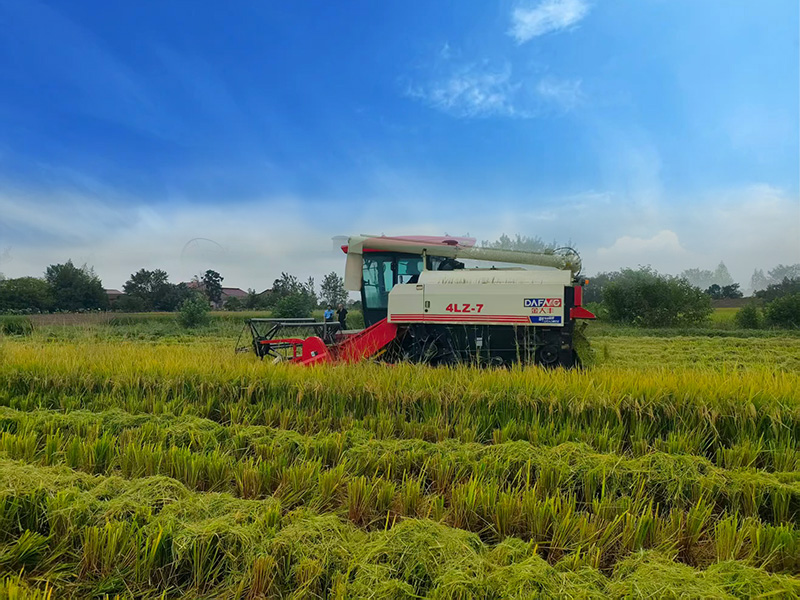
In terms of performance, these paddy harvesters meet standard industry benchmarks: rice loss stays under 3.5%, impurities below 5%, and breakage at 2% or less. They typically handle 10-20 mu (about 0.67-1.33 hectares) per day, working best in fields where mud depth doesn’t exceed 150 mm.
2. Self-Propelled Rice Harvesters
Self-propelled models are standalone combined rice harvesters with their own diesel engines and chassis, combining harvesting, threshing, cleaning, and grain collection into one unit. Many high-end versions function as rice wheat combine harvesters, adaptable to multiple crops beyond just paddy. They’re known for maneuverability and come in three main variants: crawler, wheeled, and semi-crawler. As versatile rice harvesting machines, power output varies widely—from 40 to 200 hp—with working widths of 1.6-3.0 meters and weights between 3-8 tons. Crawler-type paddy harvesting machines distribute weight evenly, with ground pressure under 30 kPa, while wheeled versions handle mud up to 200 mm deep. High-end combined rice harvesters often include automatic driving systems for precise operation, with positioning accuracy within ±2.5 cm.
Performance-wise, these harvesters for rice outperform mounted models: full-feed designs have a loss rate of ≤2.8%, half-feed models as low as ≤2.5%, and both keep impurities under 2.0%. Breakage is minimal—≤1.5% for full-feed, and just ≤0.5% for half-feed. On a good day, they can cover 30-80 mu (2-5.33 hectares), with large intelligent rice wheat combine harvesters handling up to 12 kg of grain per second.
II. Key Differences Between the Two Types
| Comparison Dimension | Tractor-Mounted | Self-Propelled |
| Power Source | Relies on tractor’s PTO | Built-in diesel engine (40-200 hp) |
| Purchase Cost | 4,300-11,500 (tractor not included) | 17,200-57,300 (small-medium: 17,200-35,800; large: 35,800-57,300) |
| Maneuverability | Tied to the tractor—nimble in small fields | Independent steering; easy to move between fields |
| Operating Efficiency | Low to medium (10-20 mu/day) | Medium to high (30-80 mu/day) |
| Suitable Scenarios | Small, fragmented plots (≤5 mu each), hilly/mountainous areas | Large continuous fields (≥10 mu each), plains |
| Maintenance | Simple to disassemble and repair; parts widely compatible | Highly integrated—hydraulic/electronic components need professional service |
| Annual Usage Need | Low (≥5 days/year to recoup costs) | High (≥20 days/year to cover depreciation) |
| Upgrade Potential | Limited—only cutting tools and cleaning systems can be upgraded | Flexible for smart upgrades (loss monitoring, automatic speed control, etc.) |
III. Where Each Model Works Best1. Tractor-Mounted Harvesters
These paddy harvesters are ideal for small-scale farmers with less than 50 mu of land, especially those in hilly or mountainous regions where fields are scattered (often ≤1 mu per plot) and slopes are gentle (≤15°). As cost-effective harvesters for rice, farmers who already own a tractor benefit most—they avoid the cost of buying a separate power unit.
Their strengths lie in covering field edges (up to 90% coverage) and handling wet, muddy conditions that challenge many rice harvesting machines. At 1/3 to 1/5 the cost of self-propelled models, these paddy harvesting machines are accessible for small operations. Maintenance is also convenient, with repair shops widely available in rural areas.
2. Self-Propelled Harvesters
Large-scale operators—family farms, cooperatives, and cross-regional harvesting teams—rely on self-propelled combined rice harvesters, especially those managing 50+ mu of land. For operations growing multiple crops, rice wheat combine harvesters offer added value by handling both grains efficiently. These rice harvesting machines excel in plain areas with continuous fields and high planting density.
As robust paddy harvesters, they work reliably for long stretches, even with challenging conditions like lodged crops or dense growth. High-end combined rice harvesters can run 24 hours straight, with intelligent systems that adjust settings in real time to minimize losses. For operations that need to cover large areas quickly, self-propelled harvesters for rice are the practical choice.
IV. Industry Trends and Challenges1. Market Imbalances
Most rice harvesting machines (73.2%) are small to medium models (40-70 hp), while high-end intelligent combined rice harvesters make up just 3.7% of the market. A major issue is reliance on imported core components for paddy harvesting machines—hydraulic systems and electronic controls, for example, are 78% dependent on foreign suppliers.
There’s also a clear supply-demand gap: small farmers need affordable, simple harvesters for rice (under 7,200), but these make up less than 1% of available options. Meanwhile, large operators need advanced **rice wheat combine harvesters**, which often cost over 35,800—putting them out of reach for many.
2. Adaptability Issues
Hilly and mountainous regions (where mechanization rates are ≤72%) face a unique problem: over 90% of paddy harvesters have working widths over 1.6 meters, too wide for fragmented fields. This leads to poor edge coverage (under 85%) and inefficient operation for these rice harvesting machines.
In double-cropping rice areas, seasonal shortages of combined rice harvesters are common—during peak harvest times, available machines can only meet 85% of demand. Additionally, cross-regional teams using rice wheat combine harvesters often face high empty travel rates (27%), wasting time and resources.
3. Future Technical Upgrades
For mounted paddy harvesting machines, the focus is on lightweight design (targeting weights under 1.2 tons) and narrower, more efficient cutting platforms (1.0-1.4 meters). This will let them work with smaller tractors (25 hp and up), expanding the usability of these harvesters for rice.
Self-propelled combined rice harvesters are moving toward domestic production of core components (aiming to cut import reliance to below 50%) and smarter features—real-time loss monitoring, better straw crushing and incorporation (targeting 95% efficiency), and increased feeding capacity (15 kg/s or more for large models). For rice wheat combine harvesters, dual-crop adaptability and quick conversion between rice and wheat operations are key upgrade directions.
V. Tips for Choosing the Right Harvester
- Match to Your Operation Size: If you have less than 50 mu, a mounted paddy harvesteris cost-effective—especially if you already have a tractor. Annual costs (purchase + maintenance) should stay under $1,400. For 50+ mu, go with a self-propelled combined rice harvester, and prioritize rice wheat combine harvesters if you grow multiple crops. Opt for models with intelligent monitoring if you handle complex conditions.
- Consider Your Terrain: Hilly or mountainous areas need narrow harvesters for rice(≤1.6 meters) or mounted paddy harvesting machines. Plains with large continuous fields work best with wide-track wheeled or crawler self-propelled rice harvesting machines.
- Check Service Availability: Choose brands of combined rice harvestersor paddy harvesters with accessible maintenance—look for at least 1.5 service points per 1,000 square kilometers. Fast response times (≤24 hours) are critical during harvest season to avoid costly delays with your rice harvesting machine
Media Contact
Company Name: Shandong Gold Dafeng Machinery Co., Ltd.
Email:Send Email
Country: China
Website: https://www.golddafeng.com/

