
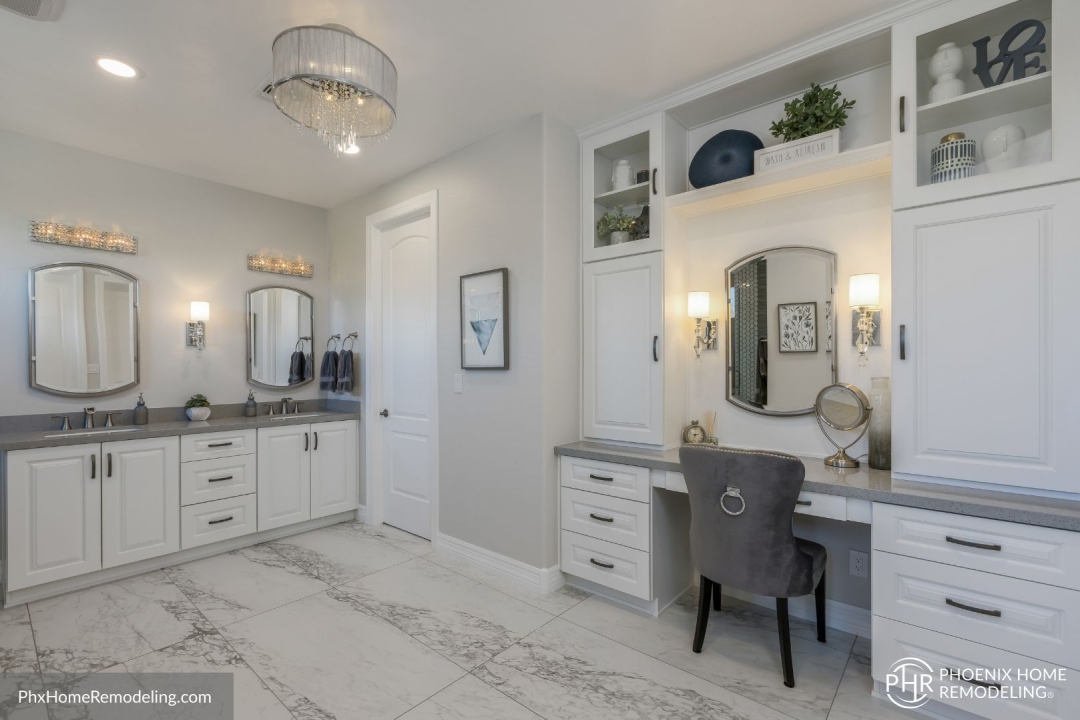
March 28, 2026 - Phoenix Home Remodeling explains why layout efficiency, storage planning, and fixture placement often matter more than room expansion.
In Queen Creek, many homeowners are staying in their homes longer and reevaluating how well their bathrooms support daily life. A room can look large on paper and still feel inefficient in practice. Oversized tubs that go unused, narrow shower enclosures, long stretches of open floor area, poor vanity storage, and awkward circulation paths are common reasons homeowners begin planning a remodel.
That is why one of the most persistent misconceptions in bathroom remodeling is the idea that better function always requires more square footage. In many cases, the problem is not that the bathroom is too small. The problem is that the existing footprint is not organized well for the way the household uses it now.
Phoenix Home Remodeling, a Phoenix-based design-build remodeling company, recently explained that for many Queen Creek bathroom remodels, better function comes from improving the current layout rather than expanding the room. Reallocating space within the existing footprint can often solve daily frustrations more effectively than moving walls, especially when storage, lighting, shower design, and circulation are planned together before construction begins.
A Larger Bathroom Is Not Automatically a Better Bathroom
Homeowners often assume that when a bathroom feels frustrating, the answer must be to make it bigger. That reaction is understandable. When people feel cramped, they tend to think in terms of added area. But in bathrooms, function is shaped less by total square footage and more by how that square footage is distributed.
A bathroom can be fairly large and still underperform if too much of the room is dedicated to features that no longer match the homeowner’s routine. This happens often in primary bathrooms where the original design prioritized a large tub deck, a separate but undersized shower, or wide open floor space that serves no real purpose. The room may technically be spacious, but the important functions remain compressed.
For example, a homeowner may walk into a primary bathroom and feel like the room should work better because it looks generous in size. Yet the daily experience may involve:
-
A shower that feels tight despite the room’s overall footprint
-
Limited drawer storage around the vanity
-
Poor lighting at the mirror
-
A bathtub that occupies a large portion of the room but sees little use
-
Door swings or circulation paths that interrupt movement
In those situations, adding square footage is not always the first or most effective answer. Reassigning space inside the existing room can create a more noticeable improvement in daily use. A larger shower, more practical storage, better access around vanities, and improved fixture placement often deliver more value than simply increasing the room’s footprint.
This misconception matters because room expansion changes the complexity of the project. Moving walls can affect adjacent rooms, flooring transitions, framing, electrical layout, cabinetry planning, and pricing. When homeowners assume expansion is required before studying the current layout carefully, they may overlook a more practical path that better matches their goals.
Function Usually Improves Through Better Allocation, Not Just More Area
When people say they want a bathroom to feel bigger, they are often describing a functional problem rather than a dimensional one. They may want a shower that feels more open, less clutter on the vanity, easier storage access, or better room flow when two people are getting ready at the same time. Those are layout and planning issues first.
A well-planned remodel can improve those experiences without changing the exterior walls of the room. In many Queen Creek bathrooms, functionality improves when the layout is reorganized around actual use patterns.
That can include decisions such as:
-
Replacing an oversized tub with a larger walk-in shower
-
Reconfiguring a double vanity to create better drawer storage
-
Converting underused open floor area into linen storage
-
Repositioning lighting so mirror use is more practical
-
Adjusting the entry or door swing to reduce circulation conflicts
-
Refining the shower opening and glass layout for a more open feel
These changes do not necessarily make the room larger, but they can make the room perform better. That distinction is important.
For many homeowners, the real goal is not to increase square footage as a number. The goal is to reduce everyday friction. A bathroom that supports daily routines more effectively can feel calmer and more usable even if the footprint remains the same.
This is especially true in primary bathrooms where the original layout may reflect older priorities. A large built-in tub once read as a premium feature in many homes, but today some homeowners would rather have a larger shower, improved storage, and better task lighting. Reworking the existing room to match current priorities can create a stronger result than expanding the room while keeping the same inefficient relationships between fixtures.
Homeowners researching bathroom remodeling in Queen Creek can review Phoenix Home Remodeling’s bathroom remodeling service information here:https://phxhomeremodeling.com/services/bathroom-remodel/queen-creek-az/
That kind of planning question is often the real starting point. Not, “How do we make the room bigger?” but, “What inside this room is not serving us well anymore?”
Expansion Can Increase Scope Without Solving the Core Problem
There are situations where moving walls makes sense. Some bathrooms truly are too small for the intended use, or a nearby closet or underused area may offer a practical opportunity for expansion. But expansion is not automatically the most strategic solution.
When a bathroom grows, the homeowner is not just paying for more room. The project scope usually broadens in multiple directions. Depending on the conditions, room expansion can involve:
-
Reframing walls
-
Reworking flooring transitions in connected spaces
-
Moving electrical locations
-
Modifying HVAC or vent paths
-
Addressing how the adjacent room will be repaired and refinished
-
Adjusting cabinetry and lighting plans across a larger footprint
That broader scope may be worth it when the existing bathroom truly lacks necessary function. But if the main problems are an underperforming shower, poor storage, or inefficient circulation, expansion may add cost and complexity without addressing the root issue as effectively as a better internal layout would.
A common example is the homeowner who wants more room because the bathroom feels crowded, yet the actual cause is a large corner tub consuming usable space. Once that tub is removed and the room is rebalanced, the bathroom may feel substantially more open without crossing into neighboring space.
Another example is vanity storage. Homeowners sometimes believe the room needs to grow because counters feel cluttered and the space feels chaotic. In reality, deeper drawers, better cabinet configuration, improved outlet placement, and a more thoughtful linen solution can change the daily experience more than added square footage would.
This is one reason planning should begin with how the room is used now, not with the assumption that expansion is the answer. Without that analysis, homeowners may commit early to a more invasive project before understanding what the current footprint is actually capable of.
The Right Question Is Whether the Layout Supports Daily Use
A bathroom remodel becomes more productive when homeowners shift from a size question to a function question. Instead of asking whether the room is large enough, it is often more useful to ask:
-
Does the shower fit how we actually use it?
-
Is there enough storage for what we use every day?
-
Can two people move through the room comfortably?
-
Is the lighting placed where it helps rather than hinders?
-
Are important features taking up space without adding real value?
These questions tend to reveal whether the room is undersized or simply underplanned.
In many Queen Creek bathroom remodels, layout adjustments inside the same footprint can create better outcomes because bathrooms are dense with function. Every few inches matter. A modest change in shower width, vanity depth, niche placement, or linen storage can affect the room more than a homeowner initially expects.
This is also why bathrooms benefit from early feasibility review. Before deciding whether expansion is necessary, it helps to understand what can be achieved by redistributing the existing square footage. That review can clarify:
-
Whether the current plumbing positions support a better arrangement
-
Whether shower enlargement is possible without moving exterior walls
-
Whether wall space can be converted into useful storage
-
Whether lighting and electrical placement are contributing to the room’s limitations
-
Whether the existing footprint can support the homeowner’s goals with better planning
When these questions are answered first, homeowners are in a stronger position to decide whether expansion is genuinely needed or whether the room can be improved more efficiently within its current boundaries.
Good Bathroom Planning Connects Layout, Storage, Lighting, and Sequencing
The myth that better function requires more space often persists because homeowners view bathroom problems one at a time. They see a small shower and think “bigger room.” They see cluttered counters and think “bigger room.” They feel cramped circulation and think “bigger room.” But in reality, those problems are connected.
A bathroom works best when layout, storage, lighting, fixture placement, and construction sequencing are planned together. A shower cannot be evaluated only by its dimensions. It also affects drain location, glass layout, tile planning, and circulation. A vanity is not just a cabinet choice. It affects storage quality, mirror sizing, lighting placement, outlet locations, and the way two users share the room.
That is why an efficient footprint can outperform a larger but poorly organized one.
A planning-first approach helps clarify those relationships before demolition begins. It allows the homeowner to see whether the remodel goals can be achieved by improving the existing room rather than automatically expanding it. This kind of evaluation usually includes:
-
Layout study
-
Storage planning
-
Plumbing and electrical review
-
Lighting coordination
-
Material and fixture selection alignment
-
Visualization before construction
When those steps happen early, the conversation becomes more grounded. Homeowners can compare options based on actual function rather than assumption.
In some cases, the conclusion will still be that more square footage is warranted. But in many cases, the most meaningful improvement comes from making the room work harder and more intelligently within the footprint already available.
Cost Implications Often Change When Expansion Enters the Scope
Another reason this misconception matters is that it affects budgeting. Homeowners may assume that if they are already remodeling the bathroom, gaining a little more square footage is a minor additional step. In practice, scope expansion can meaningfully reshape the project.
Typical planning ranges for bathroom remodels often fall into the following categories:
Primary Bathroom Remodel:
-
Standard range: $40,000 to $60,000
-
Larger or higher-finish material range: $50,000 to $75,000
-
Typical timeline: 4 to 7 weeks depending on scope
Guest Bathroom Remodel:
-
Full remodel: $18,000 to $25,000
-
Bathtub to shower conversion: $15,000 to $17,000
-
Typical timeline: 2 to 4 weeks
These planning ranges reflect full remodel scopes, but they do not mean every project requires structural expansion to feel more functional. In fact, some homeowners may find that staying within the current footprint allows them to direct more of the investment toward the parts of the bathroom they will use every day, such as shower size, cabinetry quality, storage, tile execution, lighting, and finish selections.
That is often a more useful tradeoff than allocating more of the budget to gaining additional area that may not improve the core experience proportionally.
Clarifying the Misconception Helps Homeowners Make Better Early Decisions
Bathroom remodeling decisions are often shaped by assumptions made at the beginning. One of the most common is the belief that the room must get bigger to get better. For some homes, that may prove true. But for many Queen Creek homeowners, the better outcome comes from first understanding how the current bathroom is failing and whether the existing space can be reorganized to support daily life more effectively.
The practical question is not whether a bathroom can be made larger. It is whether a larger bathroom is necessary to solve the actual problem.
When that distinction is clear early, homeowners can make more informed decisions about scope, layout, priorities, and investment before construction begins.
Third-Party Validation and Recognition
-
Named a Top Contractor in Arizona by Ranking Arizona (2024)
-
Awarded Best of Houzz – Service (2020–2026)
-
Recognized Statewide as a Leading General Contractor in Arizona by Home Builder Digest
-
Included on Home Builder Digest’s List of Best Home Remodelers in Phoenix
-
BBB Accredited Business, A+ rating
-
Member of the National Association of the Remodeling Industry (NARI)
-
4.9 rating with 200+ public reviews across major platforms
View Phoenix Home Remodeling on Google: https://goo.gl/maps/U6tzxTBVeuSbyJ7Y7
Get directions to their office: https://maps.app.goo.gl/TYW2K6uBuL1fkS4x7
See the related post on Facebook: https://www.facebook.com/792317302941664/posts/1363714892468566
See the related post on X: https://x.com/PhxHmRemodeling/status/2036510843349901381?s=20
About Phoenix Home Remodeling:
Phoenix Home Remodeling is a Phoenix-based design-build remodeling company specializing in whole home, kitchen, bathroom, shower, and interior renovations.
The company uses a planning-first process that completes feasibility, material selections, and 3D design before construction begins. Fixed construction pricing is provided only after full planning and design are finalized to reduce surprises and change orders.
Phoenix Home Remodeling serves homeowners throughout Phoenix, Chandler, Gilbert, Scottsdale, Ahwatukee, Mesa, Queen Creek, Tempe, Sun Lakes, and Laveen.
Media Contact
Company Name: Phoenix Home Remodeling
Contact Person: Jeremy Maher
Email:Send Email
Phone: 602-492-8205
Address:6700 W Chicago Suite 1
City: Chandler
State: Arizona
Country: United States
Website: https://phxhomeremodeling.com/services/bathroom-remodel/queen-creek-az/

