
Spunbond Nonwoven fabric has become an essential material across industries such as hygiene, medical, agriculture, and packaging. Unlike traditional textiles that require weaving or knitting, spunbond fabric is made through a continuous, highly efficient process that bonds fibers directly into a strong, uniform sheet. This article walks you through the step-by-step manufacturing process of spunbond nonwoven fabric and explains why it has become the material of choice for countless applications worldwide.
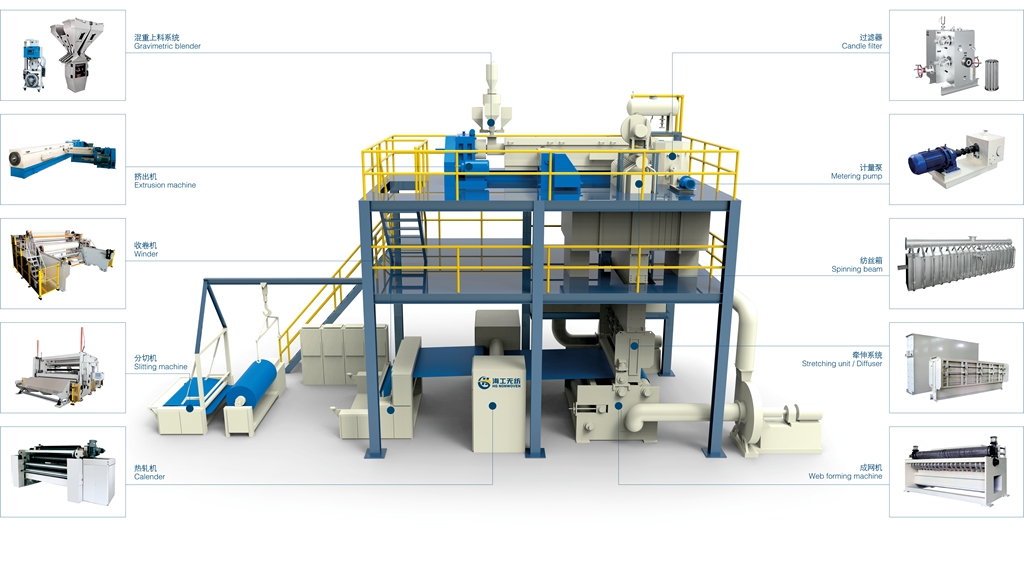
Step 1: Polymer Preparation and Extrusion
The production of spunbond nonwoven fabric begins with thermoplastic polymers, most commonly polypropylene (PP), though polyester (PET) and polyethylene (PE) are also used. The polymer is fed into an extruder, where it is heated to a molten state. During this stage, additives such as stabilizers, pigments, or flame retardants may be introduced to enhance specific properties like UV resistance or color consistency. The molten polymer is then filtered to remove impurities, ensuring a clean and consistent end product.
Step 2: Spinning and Fiber Formation
Once the polymer is melted, it is forced through a Spinneret—a precision-engineered metal plate with hundreds of tiny holes. This process forms continuous filaments that are rapidly cooled by a stream of air. Unlike staple fiber production, where fibers are cut into short lengths, spunbond technology maintains continuous filaments, which contributes significantly to the fabric’s strength and uniformity. The cooling air also helps draw the filaments to the desired thickness, which can range from fine to coarse depending on the intended application.
Step 3: Web Formation and Laydown
After cooling, the continuous filaments are evenly distributed onto a moving conveyor belt or screen, forming a loose, random web. This laydown process is carefully controlled to ensure consistent fiber distribution, which directly affects the fabric’s basis weight, uniformity, and overall quality. Vacuum systems are often used to hold the web in place as it moves to the next stage. The result is a delicate, entangled structure of filaments that has not yet gained its final strength.
Step 4: Bonding and Stabilization
To transform the loose web into a strong, durable fabric, the fibers must be bonded together. The most common method used in spunbond production is thermal bonding, where the web passes through heated calender rollers. The combination of heat and pressure causes the fibers to partially melt and fuse at their crossing points, creating a stable nonwoven sheet. Alternative bonding methods include chemical bonding using adhesives or mechanical bonding such as needlepunching, though thermal bonding remains the dominant technique for spunbond due to its efficiency and clean process.
Step 5: Finishing and Roll-Up
Once bonded, the fabric may undergo additional finishing treatments based on its intended use. Common finishing processes include hydrophilicity treatments for hygiene products like diapers and sanitary napkins, hydrophobicity treatments for medical gowns and agricultural covers, antistatic treatments, or corona surface treatment to improve printability and coating adhesion. After finishing, the fabric is trimmed to the desired width and wound onto large rolls. These rolls are then ready for shipment or further converting processes such as cutting, folding, or laminating.
Why Spunbond Nonwoven Fabric Is Widely Used
The spunbond process offers several distinct advantages that make it highly attractive for manufacturers and end users alike. Because the entire production line—from polymer to finished fabric—operates in a continuous sequence, manufacturing costs are relatively low, and large volumes can be produced efficiently. The resulting fabric offers excellent tensile strength, consistent quality, and can be engineered with a wide range of properties such as breathability, liquid repellency, or softness. Additionally, spunbond nonwoven fabrics are lightweight, durable, and fully recyclable, aligning with the growing demand for sustainable material solutions.
From medical masks and surgical gowns to shopping bags, geotextiles, and agricultural ground covers, spunbond nonwoven fabric continues to expand into new markets. Its versatility, combined with a manufacturing process that balances performance with cost-effectiveness, ensures that it will remain a foundational material across industries for years to come.
Media Contact
Company Name: HG Nonwoven Machinery
Email:Send Email
Country: China
Website: https://www.hgspuntech.com/

