
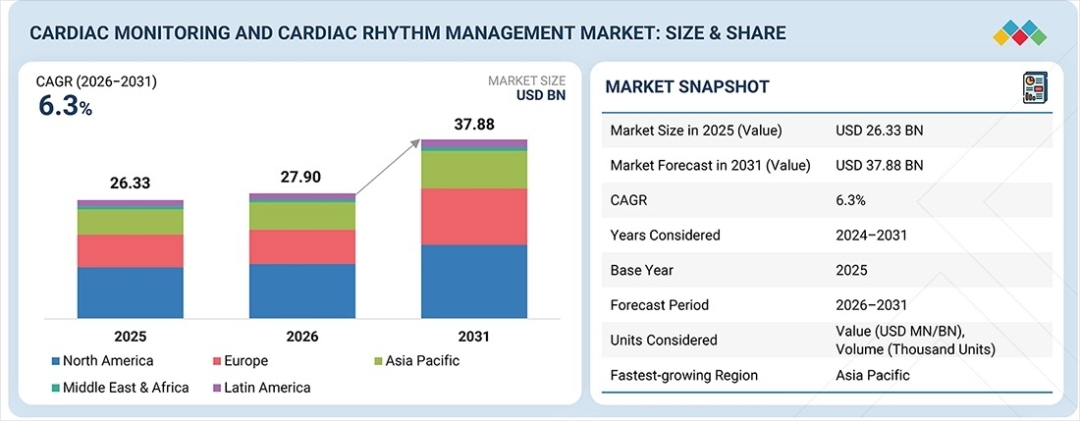
The global Cardiac Monitoring & Cardiac Rhythm Management Devices Market is poised for steady expansion, driven by the increasing burden of cardiovascular diseases and rapid technological advancements in cardiac monitoring solutions. The market is projected to grow from USD 27.90 billion in 2026 to USD 37.88 billion by 2031, registering a CAGR of 6.3% during the forecast period. The growth of the market is primarily attributed to the rising prevalence of cardiovascular disorders and arrhythmias worldwide, which continue to be among the leading causes of morbidity and mortality.
Download PDF Brochure: https://www.marketsandmarkets.com/pdfdownloadNew.asp?id=55
The growing aging population globally is a major factor contributing to the rising incidence of heart-related conditions such as atrial fibrillation, ventricular arrhythmias, and heart failure. In addition, lifestyle-related risk factors including obesity, diabetes, hypertension, and sedentary habits are further increasing the demand for effective cardiac monitoring and rhythm management solutions. Technological advancements in minimally invasive cardiac devices, wearable monitors, and remote monitoring systems are significantly improving patient outcomes by enabling early diagnosis and continuous monitoring of cardiac conditions. Moreover, the expansion of telemedicine services and the increasing adoption of home-based healthcare solutions are further accelerating the demand for advanced cardiac monitoring technologies. Favorable reimbursement policies in developed countries and improving healthcare infrastructure in emerging economies are also contributing to the sustained growth of the cardiac monitoring and cardiac rhythm management devices market.
Non-Invasive Cardiac Monitoring Devices and Resting ECG Segment Lead Market Adoption
By type, the cardiac monitoring and cardiac rhythm management devices market is segmented into non-invasive cardiac monitoring devices and implantable cardiac rhythm management devices, with the non-invasive segment accounting for the largest share of the market at 83.9%. Non-invasive cardiac monitoring devices are widely used for diagnosing and monitoring heart rhythm abnormalities without requiring surgical procedures, making them highly preferred by healthcare providers and patients alike.
Among the various diagnostic modalities, the resting ECG segment is expected to account for the largest share during the forecast period. Resting ECG remains one of the most commonly performed diagnostic tests in cardiology due to its simplicity, accessibility, and cost-effectiveness. It is widely utilized for routine cardiac screening, diagnosis, and monitoring of patients across different healthcare settings, including hospitals, clinics, and ambulatory care centers. The procedure involves recording the electrical activity of the heart while the patient is at rest, allowing healthcare professionals to detect abnormalities such as arrhythmias, ischemia, and conduction disorders.
One of the major advantages of resting ECG is its quick and non-invasive nature, making it an essential diagnostic tool in both emergency and routine clinical care. The test can be easily performed by a wide range of healthcare professionals, including primary care physicians, cardiologists, emergency department staff, and allied healthcare providers. Additionally, its affordability and widespread availability make it accessible to patients across diverse healthcare systems worldwide. As healthcare providers continue to emphasize preventive cardiology and early detection of heart diseases, the demand for resting ECG diagnostics is expected to remain strong, reinforcing its dominant position in the cardiac monitoring and rhythm management devices market.
Arrhythmia Application and Pacemakers Segment Drive Device Demand
Based on application, the cardiac monitoring and cardiac rhythm management devices market is segmented into several clinical areas, with arrhythmia accounting for the largest market share of 64.7% in 2025. The high prevalence of arrhythmias such as atrial fibrillation and ventricular arrhythmias has significantly increased the demand for advanced cardiac monitoring and rhythm management devices. Early detection and continuous monitoring of abnormal heart rhythms are crucial for preventing severe complications such as stroke, heart failure, and sudden cardiac death.
A wide range of cardiac rhythm management devices—including pacemakers, implantable cardioverter defibrillators (ICDs), cardiac resynchronization therapy (CRT) devices, and advanced cardiac monitoring systems—are commonly used for diagnosing and treating arrhythmias. These technologies enable healthcare providers to closely monitor cardiac activity and deliver timely therapeutic interventions when abnormal rhythms are detected. As awareness regarding arrhythmia diagnosis and treatment continues to grow, healthcare systems worldwide are increasingly investing in advanced monitoring technologies.
Within the pacemaker category, leadless pacemakers are expected to register the highest CAGR during the forecast period. Unlike traditional pacemakers that require leads connecting the device to the heart, leadless pacemakers are compact, self-contained devices implanted directly into the heart chamber. This design eliminates the need for leads, thereby reducing complications such as infections, lead fractures, and device malfunctions. Leadless pacemakers also offer several advantages including minimally invasive implantation procedures, shorter hospital stays, and faster patient recovery times. Their suitability for elderly patients and individuals at higher surgical risk is further driving adoption. Continuous technological advancements and increasing physician confidence in leadless pacing technologies are expected to significantly accelerate the growth of this segment over the coming years.
Get Sample Pages: https://www.marketsandmarkets.com/requestsampleNew.asp?id=55
Home Care Settings and Asia Pacific Region Emerging as Key Growth Drivers
By end user, the cardiac monitoring and cardiac rhythm management devices market is segmented into hospitals, ambulatory care centers, and home care settings. Among these, the home care settings segment is expected to register the highest CAGR during the forecast period. The growing emphasis on patient-centric healthcare models, along with the increasing availability of wearable cardiac monitors and portable defibrillators, is encouraging patients to manage chronic heart conditions from the comfort of their homes.
Remote monitoring technologies have significantly improved the ability of healthcare providers to track patients’ cardiac health in real time. These devices enable the continuous transmission of cardiac data to healthcare professionals, allowing timely medical interventions while reducing the need for frequent hospital visits. The shift toward home-based cardiac care is also supported by healthcare systems aiming to reduce hospital overcrowding, minimize readmissions, and lower overall healthcare costs. As telehealth services continue to expand globally, home care settings are expected to play an increasingly important role in cardiac monitoring and rhythm management.
From a regional perspective, the Asia Pacific region is projected to register the highest CAGR in the cardiac monitoring and cardiac rhythm management devices market during the forecast period. The region’s growth is driven by several factors, including the rising prevalence of cardiovascular diseases, growing awareness of arrhythmia management, and the rapid adoption of advanced medical technologies. Expanding healthcare infrastructure, increasing healthcare investments, and supportive government initiatives aimed at improving access to cardiac care are further contributing to market growth in the region.
Leading companies operating in the cardiac monitoring and cardiac rhythm management devices market include GE HealthCare (US), Koninklijke Philips N.V. (Netherlands), Boston Scientific Corporation (US), Baxter (US), Medtronic (Ireland), Shenzhen Mindray Bio-Medical Electronics Co., Ltd. (China), Abbott (US), Stryker (US), NIHON KOHDEN CORPORATION (Japan), MicroPort Scientific Corporation (China), FUKUDA DENSHI (Japan), OSI Systems, Inc. (US), iRhythm Inc. (US), Lepu Medical Technology (Beijing) Co., Ltd. (China), and AliveCor, Inc. (US).
These companies are actively investing in research and development, product innovation, and strategic collaborations to strengthen their global market presence. Continuous advancements in wearable cardiac monitoring technologies, implantable rhythm management devices, and digital health platforms are expected to shape the future of cardiac care and support the sustained growth of the cardiac monitoring and cardiac rhythm management devices market in the coming years.
Related Reports:
Endoscopy Equipment Market - Global Forecast to 2030
Laparoscopic Instruments Market - Global Forecast to 2030
Media Contact
Company Name: MarketsandMarkets™ Research Private Ltd.
Contact Person: Mr. Rohan Salgarkar
Email:Send Email
Phone: 18886006441
Address:1615 South Congress Ave. Suite 103, Delray Beach, FL 33445
City: Florida
State: Florida
Country: United States
Website: https://www.marketsandmarkets.com/Market-Reports/hot-melt-adhesives-market-1088.html