
Major Causes of Underground Power Cable Faults
1. Mechanical Damage
Mechanical damage is one of the leading causes of underground cable failures. In many cases, the damage does not trigger an immediate fault but gradually develops over time.
Common sources include:
-
Damage during installation, such as excessive pulling force or bending
-
External impacts from construction activities near cable routes
-
Long-term vibration from traffic loads
-
Soil settlement causing joint stress or conductor breakage
-
Sheath abrasion at ducts, supports, or pipe entries
Even minor mechanical defects can later evolve into high-resistance or flashover faults.
2. Insulation Moisture Ingress
Moisture significantly reduces insulation strength and accelerates aging.
Typical causes include:
-
Poor sealing of cable joints or terminations
-
Manufacturing defects such as pinholes in metal sheaths
-
External corrosion or puncture of the cable sheath
Moisture ingress is a primary cause of unbreakable high-resistance faults in medium- and high-voltage cables.
3. Insulation Aging and Thermal Degradation
Insulation deterioration occurs due to:
-
Internal voids and impurities under electric field stress
-
Long-term overloading and overheating
-
Poor ventilation in cable ducts
-
Oil loss in oil-paper insulated cables
-
Operation beyond designed service life
Aging insulation often leads to breakdown faults during DC withstand testing.
4. Overvoltage Stress
Overvoltage can trigger immediate insulation failure when latent defects exist.
Main sources include:
-
Lightning-induced atmospheric overvoltages
-
Switching overvoltages within the power system
5. Design and Manufacturing Defects
Improper design and manufacturing of cable joints or terminations may cause:
-
Uneven electric field distribution
-
Incompatible insulation materials
-
Non-standard production processes
These defects often result in early-stage insulation breakdown.
Classification of Cable Faults by Electrical Characteristics1. By Material Nature
-
Series Faults: Conductor or sheath breaks (open circuits)
-
Parallel Faults: Insulation failure causing short-circuits or ground faults
-
Complex Faults: Combined conductor and insulation damage
By Fault Point Insulation Resistance
| Fault Type | Key Characteristics |
|---|---|
| Open-Circuit Fault | Infinite insulation resistance, conductor discontinuity |
| Low-Resistance Fault | Insulation resistance < 10Z₀ |
| High-Resistance Fault | Insulation resistance > 10Z₀ (common in 6–10 kV cables) |
| Flashover Fault | Normal IR at rest, breakdown under high voltage |
High-resistance faults account for over 80% of medium-voltage cable failures in the field.
1. Classification by Operating BehaviorExplosion Faults
-
Severe insulation destruction
-
Obvious external damage
-
Easy acoustic location
2. Breakdown Faults
-
Occur during DC withstand tests
-
Usually high-resistance grounding
-
Difficult to locate without pulse or return-path methods
3. Running Faults
-
Occur during normal operation
-
Often intermittent or unstable
-
Commonly caused by aging or environmental corrosion
4. Common Cable Fault Detection MethodsLow-Resistance Faults
-
Insulation resistance testing
-
Time Domain Reflectometry (TDR)
5. High-Resistance Faults
-
Murray Bridge and Glaser Bridge methods
-
Secondary pulse and triple-pulse methods
-
Arc-stabilization techniques for moisture-related faults
6. Open-Circuit Faults
-
Conductor continuity testing
-
TDR waveform analysis
7. Flashover and Intermittent Faults
-
Partial discharge testing
-
Acoustic-magnetic synchronous positioning
8. Sheath Faults
-
DC sheath insulation testing
-
DC withstand voltage testing
Advanced Cable Fault Testing Equipment for Accurate Location
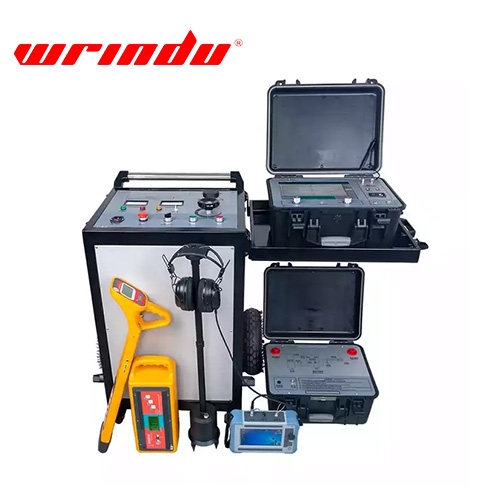
Modern cable fault diagnosis requires high-precision, field-ready instruments. The Wrindu RDCD-II-503B Cable Fault Tester is designed for efficient fault location in complex underground environments.
Key Features:
-
Acoustic-magnetic synchronous positioning
-
Automatic time-difference calculation
-
Advanced noise filtering technology
-
Adjustable gain and trigger parameters
-
5-inch high-brightness touch screen
-
Built-in lithium battery for long field operations
-
Lightweight and portable design
This technology reduces operator dependency and improves accuracy in high-resistance and flashover fault detection.
For more information, visit official website: www.wrindu.com / www.hvtesters.com
For technical blogs, visit official website: blog.wrindu.com
Media Contact
Company Name: Rui Du Mechanical and Electrical (Shanghai) Co., Ltd.
Contact Person: Wrindu
Email:Send Email
Phone: 13661908522
Address:No.500 Jianyun Road, Pudong New Area
City: Shanghai
Country: China
Website: https://www.wrindu.com/